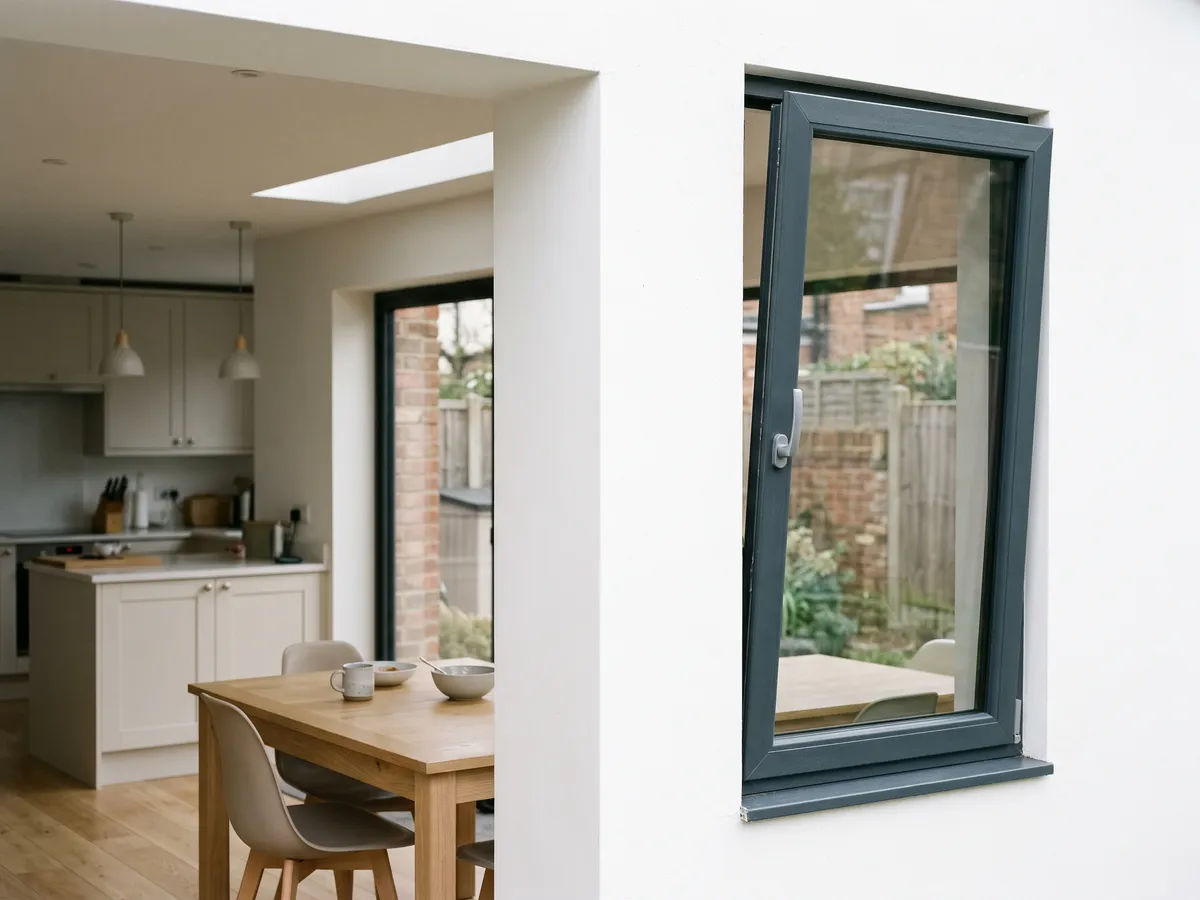
Tilt And Turn Windows.
A tilt and turn window costs about £150 more than a casement in MyJobQuote's guide: £500 to £700 against £350 to £550 for white uPVC, fitted. One handle gives a safe tilt for ventilation and an inward turn for cleaning, but the escape rules in Approved Document B measure the unobstructed opening, so check the clear gap of any bedroom window. This guide is for homeowners and flat owners weighing a tilt and turn window against a casement: it explains how it works, what it costs and the bedroom escape check, so you can compare written quotes.
Takes about two minutes. Installers pay us, so it is free for you.
- uPVC tilt and turn, fitted
- £500 - £700MyJobQuote, Oct 2026
- uPVC casement, fitted
- £350 - £550MyJobQuote, Oct 2026
- uPVC tilt and turn
- £670 - £835FMB Home Picks, Jan 2026, fitting not stated
- Minimum escape opening
- 0.33 m²Approved Document B, with 450mm minimum height and width
Sources: MyJobQuote, new windows cost guide, last updated 20 October 2026; FMB Home Picks, tilt and turn windows, updated 15 January 2026; Approved Document B, Volume 1, page updated 16 September 2026. The prices are guide figures, not Switchable's, and the two guides disagree on whether fitting is included.
In short
- Handle down locks the window, handle up tilts it inward a couple of inches at the top, and handle sideways swings the whole sash open inward like a door (FMB Home Picks, Jan 2026).
- MyJobQuote (Oct 2026) puts a fitted uPVC tilt and turn at £500 to £700 against £350 to £550 for a casement. On an eight-window house that is about £1,200 more, our arithmetic.
- An escape window must have an unobstructed opening of at least 0.33m², at least 450mm high and wide, with the bottom no more than 1,100mm above the floor. A tilt gap of a couple of inches is nowhere near that.
- In a house, rooms on a floor more than 4.5m above ground are planned around a protected stairway rather than a window. See what Approved Document B says.
- Check the swing: the open sash takes room inside, so curtains, blinds, deep sills and radiators under the window matter.
On this page (10)
How A Tilt And Turn Window Works
A tilt and turn window has one sash and one handle, with three positions. It opens inward, which is the opposite of a standard casement: MyJobQuote describes casements as swinging outward.
| Handle | What the window does | What it is for |
|---|---|---|
| Down | Locks the whole mechanism | Closed and secured |
| Up | The top of the sash tilts inward by a couple of inches and locks there; it does not open fully from the top | Ventilation, including in rain, with a narrow gap |
| Sideways | The sash swings inward on its side hinges, like a reverse casement | Full opening, and cleaning the outside from inside |
Source: FMB Home Picks, tilt and turn windows, updated 15 January 2026; read 26 November 2026.
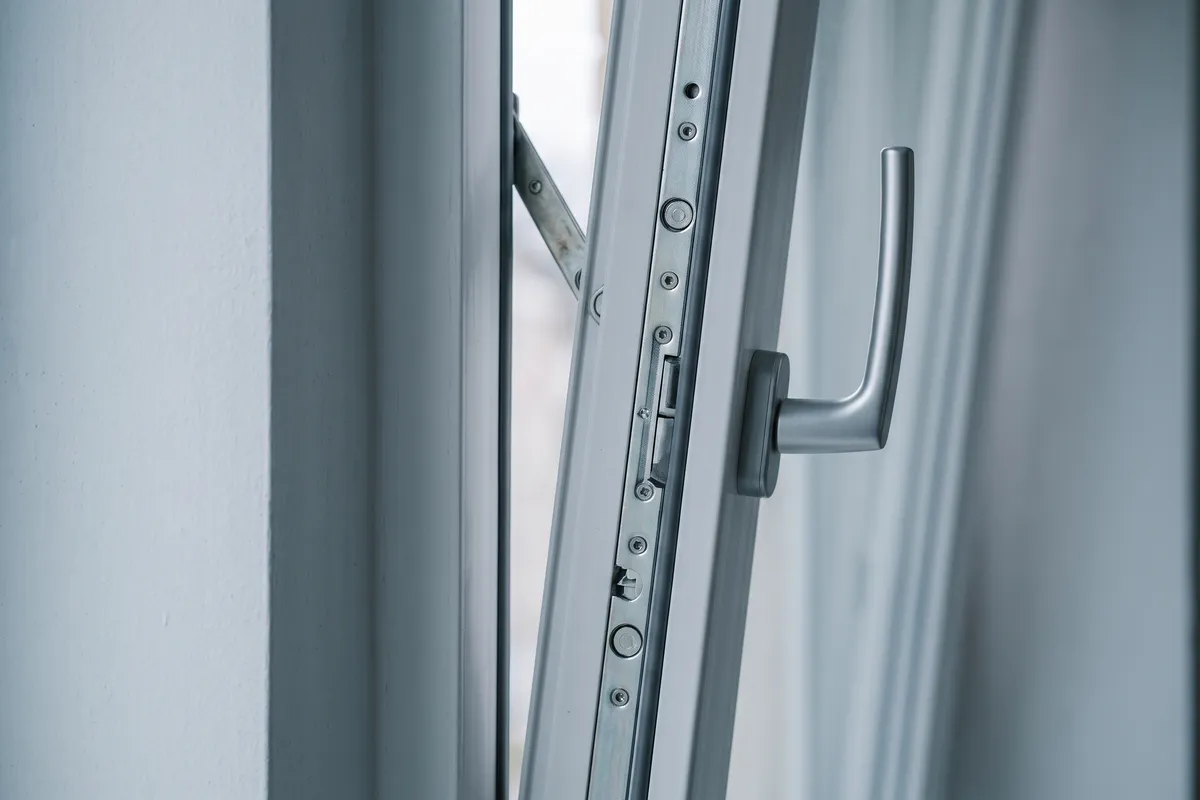
Because the sash swings into the room, two things matter that do not on a casement: what stands inside the window, and how far you can reach to clean it. FMB lists inward opening as a drawback for rooms where it does not suit, and describes the multiple mechanisms as more complex to repair than a casement.
Tilt And Turn Windows In uPVC, Aluminium And Timber: Upkeep And Repairs
The frame material changes the upkeep more than the opening style does. FMB says uPVC tilt and turn windows are the cheapest and the easiest to look after, needing only a wipe with a damp microfibre cloth, with a lifespan of up to 25 years. An aluminium tilt and turn window is strong enough for bigger sashes, weather-resistant and resists corrosion, with a lifespan of 30 years or more and low maintenance, though FMB's aluminium guide says homes near the coast should watch the coating. Timber needs the most upkeep and suits period homes and conservation areas, with permission where the building is listed, and FMB gives at least 60 years. Those lifespans are FMB's figures, not guarantees, so ask each installer what the frame and the hardware are warranted for.
Because one handle drives several locking points and hinges, repair is more complex than on a casement. FMB suggests clearing anything caught in the frame or seal, resetting the opening mechanism if the tilt function sticks, and lubricating stiff parts. It says to call a professional if the window is broken, draughty or has condensation between the panes. When closed and locked, FMB says the window works as a picture window, so a sash that will not lock is a security and draught problem, not just an annoyance.
Where Tilt And Turn Windows Suit, And Where They Do Not
The style earns its extra cost in a few specific places. It is not an upgrade for every window in the house.
Upper floors and flats
You can clean the outside from inside, which matters when a ladder is not an option. The tilt gives ventilation without a wide opening, and FMB says the angled opening can help where children might climb out.
Rooms where ventilation matters
FMB says the angled tilt lets fresh air in during rain while keeping water out,
Narrow paths, balconies and bins outside
An inward-opening window cannot hit anything outside. A standard casement opens outward and needs clear space, and FMB lists that as a casement drawback.
Less suited: furnished sills and full curtains
Radiators, deep-sill plants, curtains and blinds all sit in the path of the sash, and a tilt and turn stays in the room when turned open.
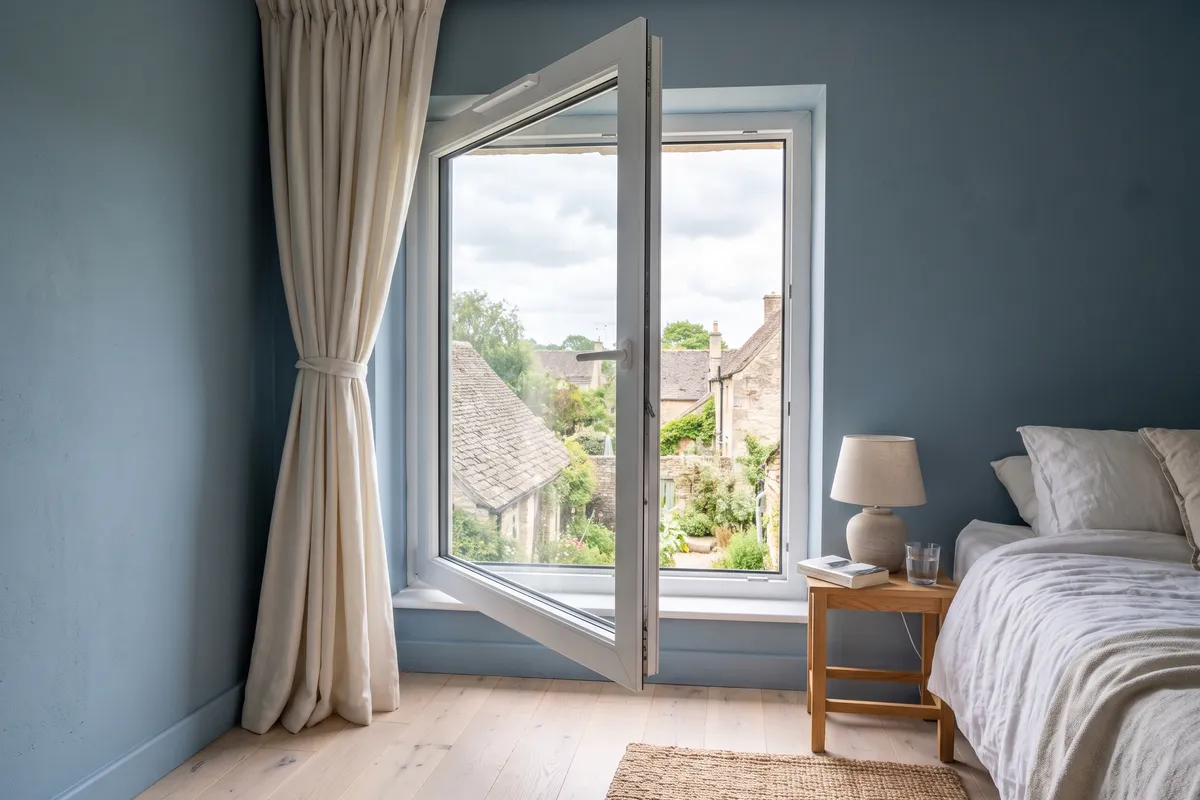
The pros and cons from FMB's guide: it is versatile, good for ventilation and safer for young children when open at an angle; against that, it costs more than a casement, opens inward and is more complex to repair.
High-Rise, Flats And Escape Routes
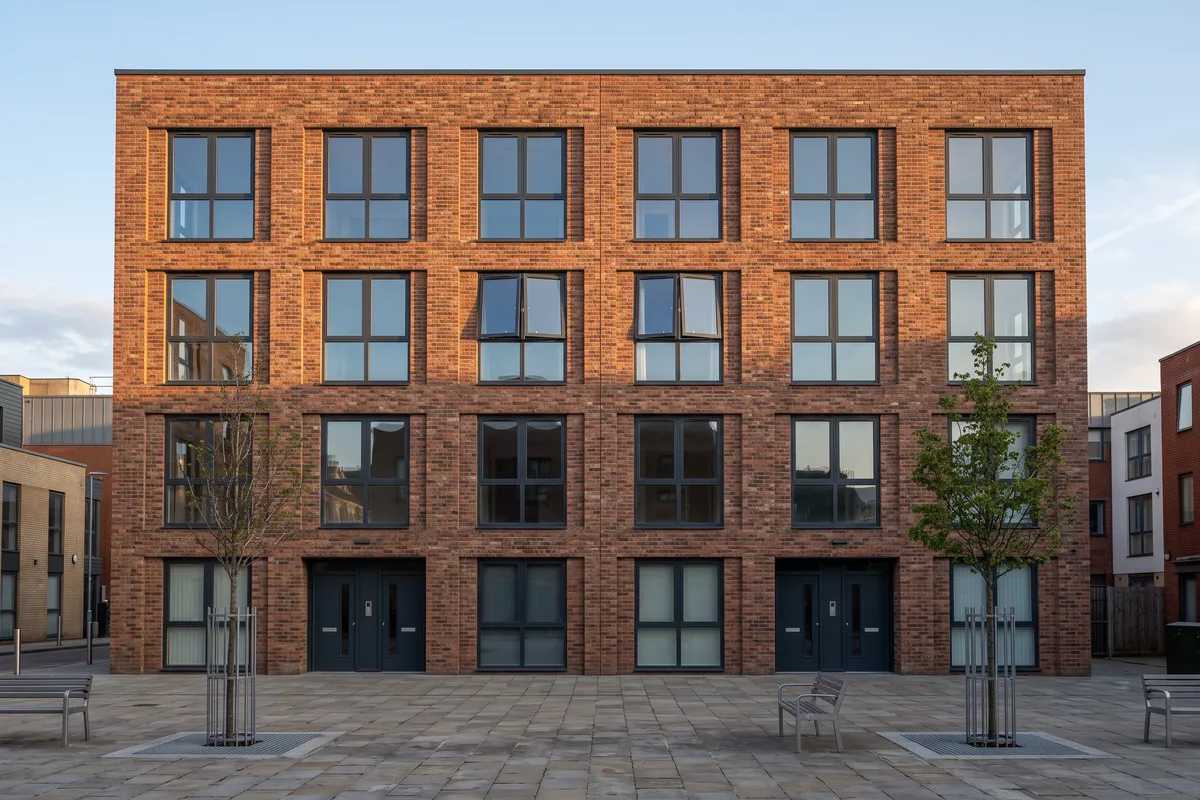
This is the check that most buyers miss. Approved Document B, the fire safety guidance for England, says which rooms need an escape window and exactly how big the opening must be. The rule measures the unobstructed openable area, which is where a tilt and turn needs care. The rules below are for dwellings in England, as the guidance reads, and the building control body decides.
| Situation | What the guidance says | Paragraph |
|---|---|---|
| House, upper storey no more than 4.5m above ground, one stair | Each habitable room except the kitchen needs an escape window or door, or direct access to a protected stairway | 2.2 |
| House with a storey more than 4.5m above ground | A protected stairway separated by fire-resisting construction is the guidance route, not a window | 2.5 |
| Flat, upper storey no more than 4.5m above ground | Each habitable room except the kitchen needs an escape window or external door, or in a multi-storey flat direct access to a protected internal stairway | 3.16 |
| Flat with a storey more than 4.5m above ground | Internal planning with a protected entrance hall, short travel distances or an alternative exit, rather than relying on a window | 3.18 and 3.19 |
| The window itself | At least 0.33m² unobstructed, at least 450mm high and 450mm wide, bottom of the openable area no more than 1,100mm above the floor, able to stay open without being held. Locks and child-resistant stays are allowed | 2.10 and 3.6 |
| Replacing a window | The new one should give at least the same potential for escape. If the old one was larger than needed it can be reduced to the minimum | 2.19 |
Source: Approved Document B, Volume 1: Dwellings, 2019 edition incorporating amendments to 2026 (GOV.UK page updated 16 September 2026); Planning Portal, building regulations for doors and windows, undated, which gives the same opening criteria; read 26 November 2026.
Work the numbers. Any opening that is at least 450mm each way and 0.33m² will pass the size test: 450mm wide by 733mm high, 600 by 550mm, or 733 by 450mm all work. The tilt position of a couple of inches is about 50mm, well under the 450mm minimum, so only the turn position can count. In turn mode the sash and hinge take up part of the opening, so ask the installer to measure the clear gap with the sash fully open and put it on the quote for any bedroom.
For a flat more than 4.5m up, the guidance plans escape through protected hallways, short travel distances or an alternative exit rather than a window, and a leaseholder may also need permission from the landlord or management company before changing windows (Planning Portal). Do not assume a tilt and turn can replace an existing window without asking the building manager and building control.
Tilt And Turn Window Security And Ventilation
FMB says tilt and turn windows offer superior security but gives no detail, so treat that as the maker's claim and ask for evidence. The police-backed Secured by Design guide for new homes sets out what evidence looks like.
| Point | What the source says | What to ask for |
|---|---|---|
| Security testing | Secured by Design Homes 2023: easily accessible windows must be certificated to PAS 24:2016, PAS 24:2022 or another listed standard | The PAS 24 certificate for the exact window, in the quote |
| Locking and escape | Secured by Design: key-lockable hardware on accessible windows unless they are designated emergency egress routes. Building regulations allow locks, with or without removable keys, on escape windows | Which windows have key locks, and which are your escape windows |
| Upper floors | Secured by Design: windows that are not easily accessible need lockable hardware or an opening restrictor in the interests of child safety | A restrictor on any window where a fall is possible, if it still leaves the escape opening where one is needed |
| Ventilation | FMB: the tilt lets air in during rain while keeping water out. Planning Portal: ventilation rules depend on the room, and trickle vents may suffice in some | Whether trickle vents are included, and which rooms need extract |
Source: Secured by Design, Homes 2023 guide, paragraphs 24.2 to 24.6 (it applies to new-build applications made after 1 March 2023, so it is a benchmark for a replacement, not a rule); FMB Home Picks, tilt and turn windows, 15 January 2026; Planning Portal, building regulations for doors and windows, undated; Approved Document B; read 26 November 2026.
What Tilt And Turn Windows Cost Against Casement
Every guide we read puts tilt and turn above a standard casement in the same material. The gap in MyJobQuote's table is the same £150 at both ends of the uPVC range, and similar for aluminium and timber.
| Material | Casement | Tilt and turn |
|---|---|---|
| uPVC, white | £350 to £550 | £500 to £700 |
| Aluminium | £600 to £850 | £750 to £1,000 |
| Timber | £750 to £1,100 | £900 to £1,200 |
Source: MyJobQuote, new windows cost guide, last updated 20 October 2026. The same guide has a tradesperson saying tilt and turn is about £100 to £150 more per window; read 26 November 2026.
Other guides give different figures for tilt and turn itself, and they do not agree on what is included.
- MyJobQuote's double glazed windows guide (9 July 2026): uPVC £400 to £700, aluminium £700 to £1,300, timber £900 to £1,500.
- FMB Home Picks (15 January 2026): uPVC £670 to £835, aluminium £875 to £1,085, timber £2,040 to £2,515, with fitting not stated.
- ExpertSure (prices verified November 2026): timber tilt and turn £900 to £1,200 installed.
- Homebuilding & Renovating (23 April 2025, older): about 25% more than a casement.
Source: MyJobQuote, double glazed windows cost guide; FMB Home Picks, tilt and turn windows; ExpertSure, timber windows; Homebuilding & Renovating, new window costs.
Work it through for an eight-window house in white uPVC, at MyJobQuote's per-window prices. All casements: 8 x £350 to £550 is £2,800 to £4,400. All tilt and turn: 8 x £500 to £700 is £4,000 to £5,600, about £1,200 more. Tilt and turn in three upper bedrooms and casements in the other five: £3,250 to £4,850. That mix is why asking for each window to be priced separately can save money.
What To Check In A Tilt And Turn Quote
Because the style is more mechanical than a casement, the hardware is where quotes differ. Ask each installer for the same four things.
The escape opening
For every bedroom, the clear opening in turn mode in millimetres, and confirmation that it meets 0.33m² and 450mm each way.
The hardware
The make of the hinges and locking strip, what guarantee covers them, and whether the sash stays open without being held. FMB says repair is more complex than for a casement.
The security certificate
A PAS 24 certificate for the exact window, with key-lockable handles where you want them.
The room and the paperwork
Where curtains, blinds and radiators sit relative to the swing, the Window Energy Rating label, and the FENSA or CERTASS certificate on completion.
Switchable is independent of any window maker or installer and is not paid by one for this page. Some installers we introduce customers to may also fit these windows. Read more on how we write our pages. To compare tilt and turn with the other two main styles, see our guides to casement windows, which has a three-way table, and sash windows.
The Bottom Line
Tilt and turn is worth the extra £150 or so a window in rooms where you want safe ventilation in rain, or can only clean from inside: upper floors and flats are the obvious cases. MyJobQuote (Oct 2026) puts a fitted uPVC one at £500 to £700 against £350 to £550 for a casement, so a whole house of them costs around £1,200 more on eight windows.
Measure before you commit. The escape rules look at the unobstructed opening, so ask for the clear gap in turn mode for every bedroom, and check what stands inside the swing. Compare quotes for the same hardware, security certificate and energy rating.
Compare window and door quotesSources
- GOV.UK, Approved Document L, conservation of fuel and power, 2021 edition incorporating 2023 amendments
- Planning Portal, planning permission for doors and windows
- FMB Home Picks, tilt and turn windows, January 2026
- FMB Home Picks, aluminium windows, January 2026
Checked 26 November 2026.
How To Compare Quotes
Get at least three quotes and compare them line by line. Prices for the same job can differ a lot.
- A price for each window and door. One total hides where the money goes, so ask for every window and door on its own line.
- The same specification on every quote: frame material, glass, energy rating, and whether the old frames are removed and made good.
- A competent person scheme certificate. Ask whether the installer is registered with Fensa, Certass or another scheme and will certify the work, and whether the 20% VAT is in the price.
How Switchable works
 Check. Tell us your postcode and a few details about your home. It takes about two minutes.
 Compare. Local installers who cover your area get in touch with quotes.
 Switch. Go ahead with the quote that suits you, or none at all. There is no obligation.
Switchable is free to use. Installers pay us for each introduction.
More On Windows And Doors
- Windows and doors guideCosts, savings and grants in one place
- Casement WindowsStandard and flush casements, materials, prices and how they compare
- Sash WindowsRepair, secondary glazing or replacement, with rules and prices
- New Windows CostPer-window prices by material, from named guides
- uPVC vs Aluminium WindowsuPVC or aluminium windows: frames, energy rating, lifespan and price
Tilt And Turn Windows: Your Questions.
How does a tilt and turn window work?
One handle with three positions. Down locks it, up tilts the top inward a couple of inches for ventilation, and sideways swings the whole sash inward like a door (FMB Home Picks, January 2026).
Are tilt and turn windows more expensive than casement windows?
Yes in every guide we read. MyJobQuote (October 2026) gives £500 to £700 for uPVC tilt and turn against £350 to £550 for a casement, and aluminium and timber follow the same pattern.
Can a tilt and turn window be used as a fire escape?
Only in turn mode, and only if the clear opening meets Approved Document B: at least 0.33m², at least 450mm high and wide, and the bottom no more than 1,100mm above the floor. The tilt gap is far too small. Ask the installer for the measured clear opening.
Do I need an escape window in a flat?
For a flat with upper storeys up to 4.5m above ground, Approved Document B says each habitable room except the kitchen needs an escape window or external door, or in a multi-storey flat direct access to a protected internal stairway. Higher flats are planned around protected hallways instead. Leaseholders may also need landlord permission before changing windows, so ask the building manager.
Are tilt and turn windows secure?
FMB calls them secure but gives no detail. Ask for a PAS 24 certificate for the exact window, which is what Secured by Design Homes 2023 requires for easily accessible windows in new homes.
Are tilt and turn windows good for ventilation?
FMB says the tilt lets fresh air in during rain while keeping water out. Trickle vents may also be required: Planning Portal says rules depend on the room.
Why do tilt and turn windows open inward?
It lets you clean the outside from inside, and it keeps the open sash clear of the wall and anything outside. The drawback is that curtains, blinds and furniture have to avoid the swing.
Can I swap my casements for tilt and turn windows?
Usually, if the opening is the same size, but building regulations apply and a bedroom escape window must keep at least the same potential for escape. In a conservation area or listed building the style change may also need permission.
What are tilt and turn windows made of?
uPVC, aluminium or timber. FMB gives about £670 to £835 for uPVC, £875 to £1,085 for aluminium and £2,040 to £2,515 for timber, with fitting not stated. It describes uPVC as the easiest to maintain, aluminium as strong enough for bigger windows, and timber as needing the most upkeep.
How do I fix a tilt and turn window that will not tilt?
FMB suggests clearing anything caught in the frame or seal, resetting the opening mechanism and lubricating stiff parts. If the window is broken, draughty or has condensation between the panes, call a professional, because the mechanism is more complex than a casement's.
Get Your Free Quotes Today.
Compare quotes from installers in your area. It takes about two minutes and there is no obligation.