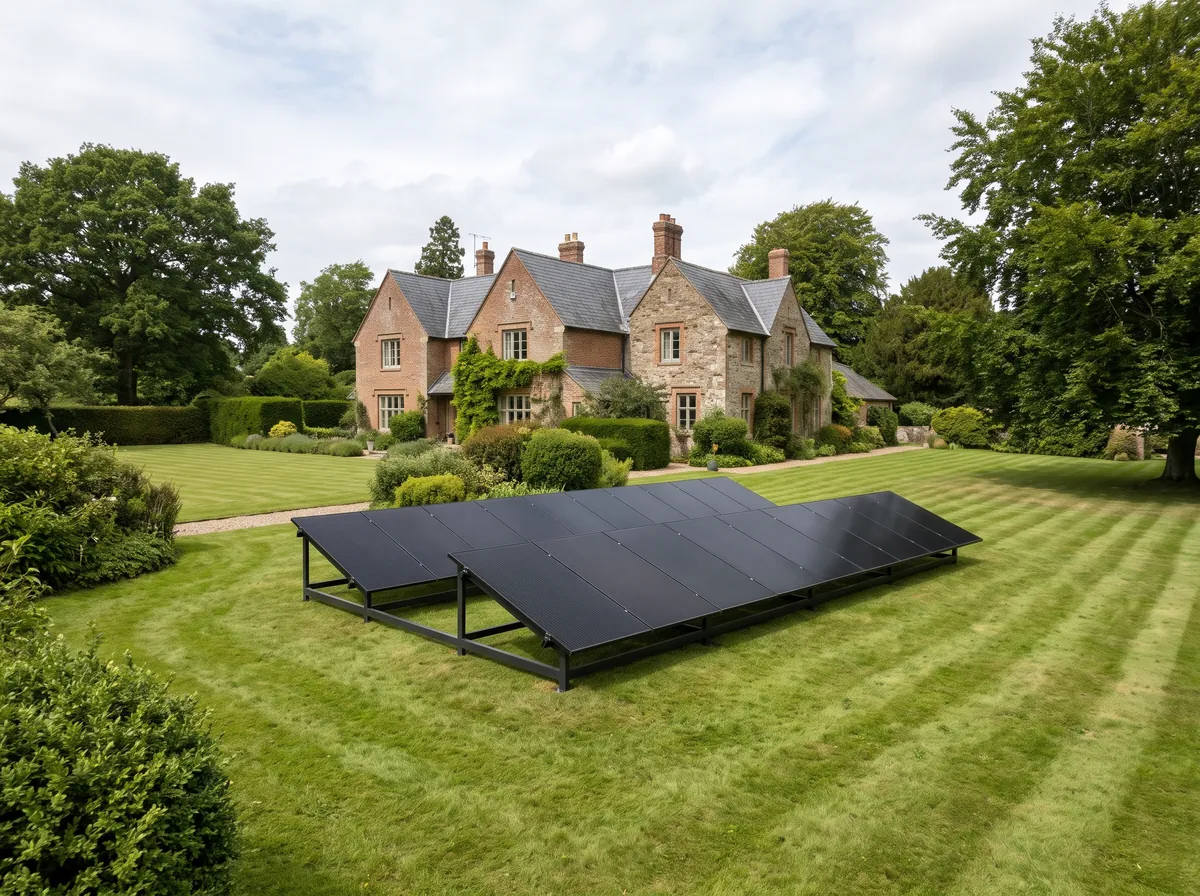
Ground-Mounted Solar Panels.
When the roof is not the right place, panels on a frame in the garden or field can work. The planning limits matter more than most people expect.
Takes about two minutes. Installers pay us, so it is free for you.
- Largest stand-alone array
- 9m²without planning permission, England and Wales
- Highest part of the array
- 4min most cases
- England rules changed
- 27 Aug 2026old rules apply until 27 Aug 2027
Source: Planning Portal, stand-alone solar in the grounds of a house and gov.wales, planning permission for solar panels, checked 17 November 2026.
What Are Ground-Mounted Solar Panels?
They are panels fixed to a frame set in the ground, in a garden, paddock or other land, instead of on a roof. The electricity travels to your home along a cable.
Panels on a frame can be angled and turned towards the sun, and they are easy to reach for cleaning and repair. Our solar panels guide covers the roof route.
When Does A Ground Mount Make Sense?
Ground mounting suits a roof that is shaded, faces the wrong way, is too small, has an awkward structure or cannot take the weight. It also suits homes with spare land, and outbuildings with no power supply.
If your roof is a good fit, a roof system is usually simpler, so ask installers to price both.
Do I Need Planning Permission For Ground-Mounted Panels?
Often a small array is permitted development, but it is easy to go over the limits. In England the limits changed on 27 August 2026, with a transition period to 27 August 2027 during which you can follow either the old or the new rules. Under the new rules the array must be no more than 9 square metres. Maximum height is 4 metres, 2 metres within 5 metres of the boundary and 1 metre if it is within 5 metres of the boundary and in front of the principal elevation (the front of the house). A conservation area can mean prior approval, and it cannot be within the boundary of a listed building or scheduled monument.
In Wales the rules say only one stand-alone installation is permitted, no higher than 4 metres, 2 metres within 5 metres of the boundary, at least 5 metres from the highway, no dimension over 3 metres and a panel surface of no more than 9 square metres.
In Scotland, free-standing panels in a house's grounds fall under Class 3B of the planning rules. We could not confirm its limits, so check with your council. Nine square metres is only a handful of panels, so a larger array needs a planning application.
Source: Planning Portal, stand-alone solar in the grounds of a house, gov.wales, planning permission for solar panels, Scottish Government, planning circular 1/2024, all checked 17 November 2026.
How Much Do Ground-Mounted Panels Cost?
We have not found a primary-source price for ground-mounted systems, so we do not quote one. The Energy Saving Trust says an average home roof system costs around £7,600 for about 4.5 kWp, but that is a roof figure.
A ground mount needs a frame, groundwork and a cable run to the house. Ask installers to itemise those, and to say what happens if the ground is soft or sloping.
Source: Energy Saving Trust, solar panels, 16 November 2026.
Are There Any Downsides To Ground Mounting?
You need space, and the array is visible from outside, which is why the planning limits are strict about siting. Grass and weeds can grow up around a low array and cast shade, so the area needs keeping clear. The Energy Saving Trust says rain keeps panels tilted at 15 degrees or more clean, and our cleaning guide covers the rest.
Source: Energy Saving Trust, solar panels, 16 November 2026.
How Is A Ground Mount Installed?
The installer surveys the site, plans the position of the frame, prepares the ground, fits the frame and panels, runs the cable to the house and connects the system. Ask how long the groundwork will take, and how the cable run is protected.
For Smart Export Guarantee payments you need an MCS-certified installation and a meter that records half-hourly export.
Source: GOV.UK, Smart Export Guarantee, checked 17 November 2026.
Is There VAT Relief Or A Grant?
HMRC zero-rates installing solar panels in homes until 31 March 2027, after which VAT reverts to 5%. Ask your installer whether that covers a ground-mounted system at your home. The Energy Saving Trust says there are no dedicated solar panel grants from the UK Government.
Source: HMRC VAT Notice 708/6, checked 17 November 2026; Energy Saving Trust, solar panels, 16 November 2026.
Pros And Cons
Pros
- Works when the roof is shaded, small or the wrong direction
- Easier to reach for cleaning and maintenance
- Can be angled towards the sun
- Can power outbuildings away from the house
- Small arrays can be permitted development
Cons
- Needs enough space on your land
- Permitted development is capped at 9 square metres
- Groundwork and cabling add to the cost
- Visible, so planning rules on siting are stricter
- Vegetation and weeds must be kept clear
How To Compare Quotes
Get at least three quotes and compare them line by line. Prices for the same job can differ a lot.
- The installer is MCS certified. You need an MCS-certified system to be paid for exported power under the Smart Export Guarantee.
- What is in the price: panels, inverter, any battery, scaffolding and waste removal.
- Warranties on the equipment and on the installation work, and who stands behind them.
How Switchable works
 Check. Tell us your postcode and a few details about your home. It takes about two minutes.
 Compare. Local installers who cover your area get in touch with quotes.
 Switch. Go ahead with the quote that suits you, or none at all. There is no obligation.
Switchable is free to use. Installers pay us for each introduction.
Ground-Mounted Solar Panels: Your Questions.
Is a ground-mounted array more expensive than a roof system?
Usually the frame, groundwork and cable run add cost, but we have not found an official price comparison. Ask installers to itemise those extras and to quote a roof system alongside, so you can see the difference for your own property.
How big can a ground-mounted array be without planning permission?
In England and Wales the surface of a stand-alone array should not exceed 9 square metres, along with limits on height and distance from boundaries. Anything larger, or a second array, needs a planning application. Check the current rules for your address with your council.
Can I put ground-mounted panels in my front garden?
Be careful. England's new rules set a 1 metre height limit within 5 metres of the boundary and forward of the principal elevation, and conservation areas can need prior approval. In Wales the array must be at least 5 metres from the highway. Ask your council before you commit.
Do ground-mounted panels need more maintenance?
A little, mostly keeping vegetation clear so it does not shade the panels. The Energy Saving Trust says rain keeps panels tilted at 15 degrees or more clean. Check the frame and cable after storms, and ask your installer what is covered by the warranty.
Can ground-mounted panels charge an electric car?
Yes, the power can be used the same way as roof panels, including for a home charger. Our guide to charging a car with solar explains how, and a battery can help if you charge in the evening. Ask the installer whether the cable run and consumer unit can take a charger.
Get Your Free Quotes Today.
Compare quotes from installers in your area. It takes about two minutes and there is no obligation.