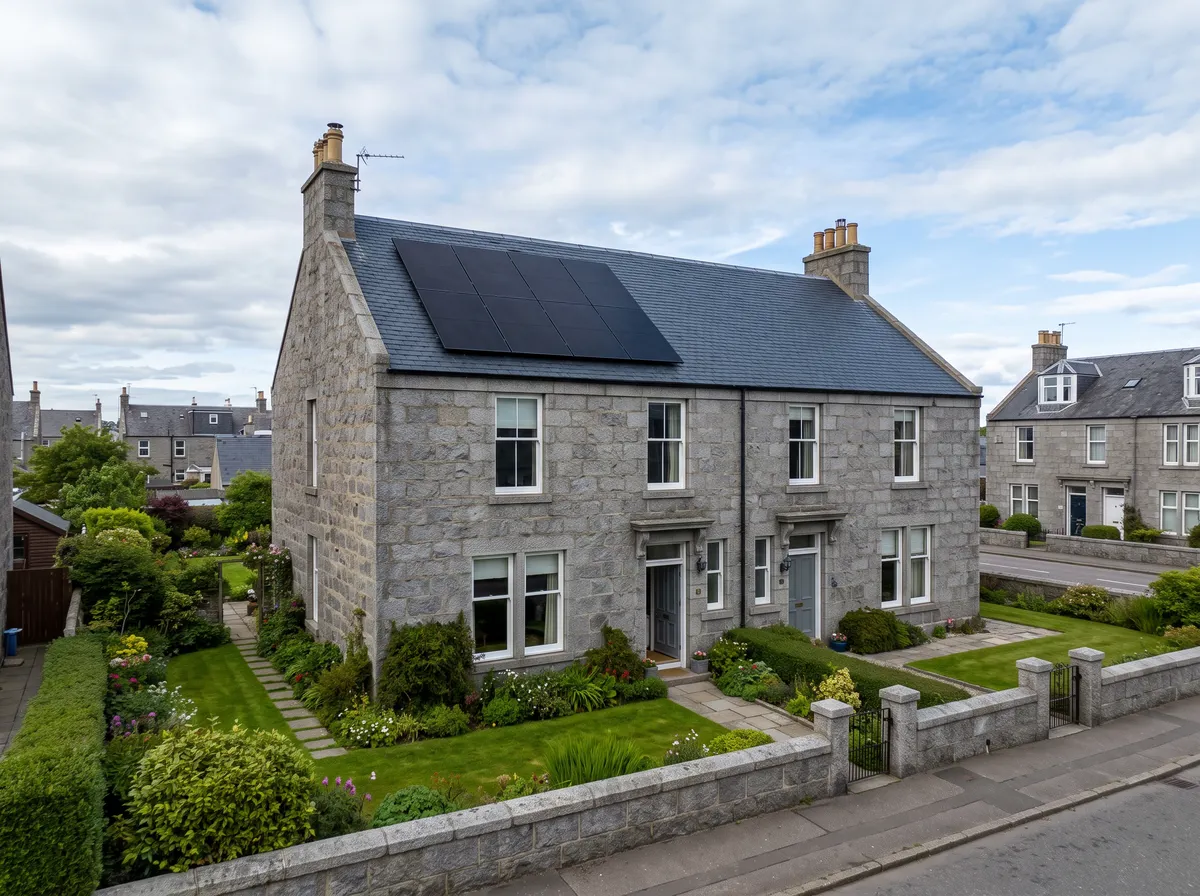
Solar Panels In Scotland.
Scotland has less sun than the south, but payback is still around 11 to 12 years near Stirling. Here is what loans exist, what the planning rules say and what is different.
Takes about two minutes. Installers pay us, so it is free for you.
- Payback near Stirling
- 11-12 yrsincluding export payments
- Interest-free loan limit
- £5,000for solar thermal and PV-T
- VAT on home solar
- 0%until 31 March 2027, Great Britain
Source: Energy Saving Trust, solar panels, 16 November 2026; Home Energy Scotland, grants and loans; HMRC VAT Notice 708/6, checked 17 November 2026.
Do Solar Panels Work In Scotland?
Yes. Panels need daylight rather than direct sun, so they keep generating when it is overcast, just at a lower rate. Direction and shade matter, and an installer will check both at the survey.
The Energy Saving Trust gives payback times with export payments. Near Stirling that is 11 years for a home in all day or half the day, and 12 years for someone out all day.
Source: Energy Saving Trust, solar panels, 16 November 2026, fuel prices July 2026.
How Much Do Solar Panels Cost In Scotland?
The Energy Saving Trust puts an average home system, about 4.5 kWp, at around £7,600 to install. That is its general figure, not a Scotland-specific price, and the actual cost depends on your roof and equipment.
Get at least three quotes, as the Energy Saving Trust advises. Our solar panels guide explains what drives the price.
Source: Energy Saving Trust, solar panels, 16 November 2026.
Is There A Grant Or Loan For Solar In Scotland?
Home Energy Scotland lists interest-free loans of up to £5,000 for solar thermal (water heating) and for hybrid solar PV and water heating (PV-T). No grant is listed for these. Standard solar PV and battery storage are not listed on its page.
To qualify you must own your only or primary private residence in Scotland, and use an MCS-certified installer and product. There is a 1.5% administration fee, capped at £150, and funding is first come, first served. Eligibility rules apply.
Source: Home Energy Scotland, grants and loans, checked 17 November 2026.
Is VAT Charged On Solar In Scotland?
In Great Britain, installing solar panels in a home is zero-rated for VAT until 31 March 2027, after which VAT reverts to 5%. Your installer applies it on the quote. The Energy Saving Trust says there are no dedicated solar panel grants from the UK Government.
Source: HMRC VAT Notice 708/6, checked 17 November 2026; Energy Saving Trust, solar panels, 16 November 2026.
Do I Need Planning Permission In Scotland?
Often not. For solar panels on a house, the rules say no part should protrude more than 1 metre from the outer surface of a wall, roof plane, ridge or chimney. They are not permitted on a listed building or in a World Heritage Site. In a conservation area, they are permitted only on a rear elevation, or a side elevation not fronting a road.
Free-standing panels in a dwelling's grounds fall under Class 3B, whose limits we could not confirm. Check with your council. This differs from England and Wales, so do not rely on English guidance.
Source: Scottish Government, planning circular 1/2024, checked 17 November 2026.
Can I Earn From Exporting Power In Scotland?
Yes. The Smart Export Guarantee applies in England, Scotland and Wales. You apply to a supplier, which need not be your own, and you need an MCS-certified installation and a meter that records half-hourly export. Rates are set by the supplier and must be above zero.
Source: GOV.UK, Smart Export Guarantee, checked 17 November 2026.
Should I Add A Battery Or Go Off-Grid?
A battery stores daytime power for the evening, but the Energy Saving Trust says savings will not always justify the cost. See our battery guide. For remote properties, off-grid systems are covered separately. In Wales, rules differ: see solar panels in Wales.
Source: Energy Saving Trust, battery storage, 6 October 2026.
Pros And Cons
Pros
- Panels work in daylight, not only in direct sun
- Payback of 11 to 12 years near Stirling, per the Energy Saving Trust
- Interest-free loans of up to £5,000 for solar thermal and PV-T, if eligible
- Zero-rated for VAT until 31 March 2027
- Export payments under the Smart Export Guarantee
Cons
- Payback is longer than in London
- Home Energy Scotland does not list standard solar PV for loans
- Planning rules differ from England and Wales
- Free-standing panels need checking with your council
- Funding is first come, first served
How To Compare Quotes
Get at least three quotes and compare them line by line. Prices for the same job can differ a lot.
- The installer is MCS certified. You need an MCS-certified system to be paid for exported power under the Smart Export Guarantee.
- What is in the price: panels, inverter, any battery, scaffolding and waste removal.
- Warranties on the equipment and on the installation work, and who stands behind them.
How Switchable works
 Check. Tell us your postcode and a few details about your home. It takes about two minutes.
 Compare. Local installers who cover your area get in touch with quotes.
 Switch. Go ahead with the quote that suits you, or none at all. There is no obligation.
Switchable is free to use. Installers pay us for each introduction.
More On Solar Panels
Solar Panels In Scotland: Your Questions.
Are solar panels worth it in Scotland?
They can be. The Energy Saving Trust gives payback of 11 to 12 years near Stirling, including export payments, against 9 years in London. That is longer, so compare quotes and work out whether it suits your plans for staying in the property. Our are solar panels worth it? guide has more.
Does Home Energy Scotland give grants for solar panels?
Its page lists interest-free loans of up to £5,000 for solar thermal and for hybrid PV-T, and says no grant is available for them. Standard solar PV is not listed. Funding is first come, first served and subject to availability, so check the current position with Home Energy Scotland.
What is PV-T?
Hybrid solar PV and water heating panels. They make electricity and heat water from the same panel. Home Energy Scotland says only PV-T systems qualify for its hybrid loan, not other hybrid set-ups. Ask installers whether it is a fit for your roof and hot water use.
Which way should panels face in Scotland?
South-facing roofs generate the most. East and west-facing roofs still work, with less output. Shade from trees, chimneys or nearby buildings matters as much as direction, so an installer will check both at the survey. Ask installers how they have allowed for your roof when they estimate yearly output.
Do panels work in Scottish winters?
Yes, at a lower output, because daylight is shorter. Panels need daylight rather than direct sun. The Energy Saving Trust gives payback by location, so use those figures rather than guessing. Ask installers what they expect your system to produce across the year, not just in summer.
Get Your Free Quotes Today.
Compare quotes from installers in your area. It takes about two minutes and there is no obligation.