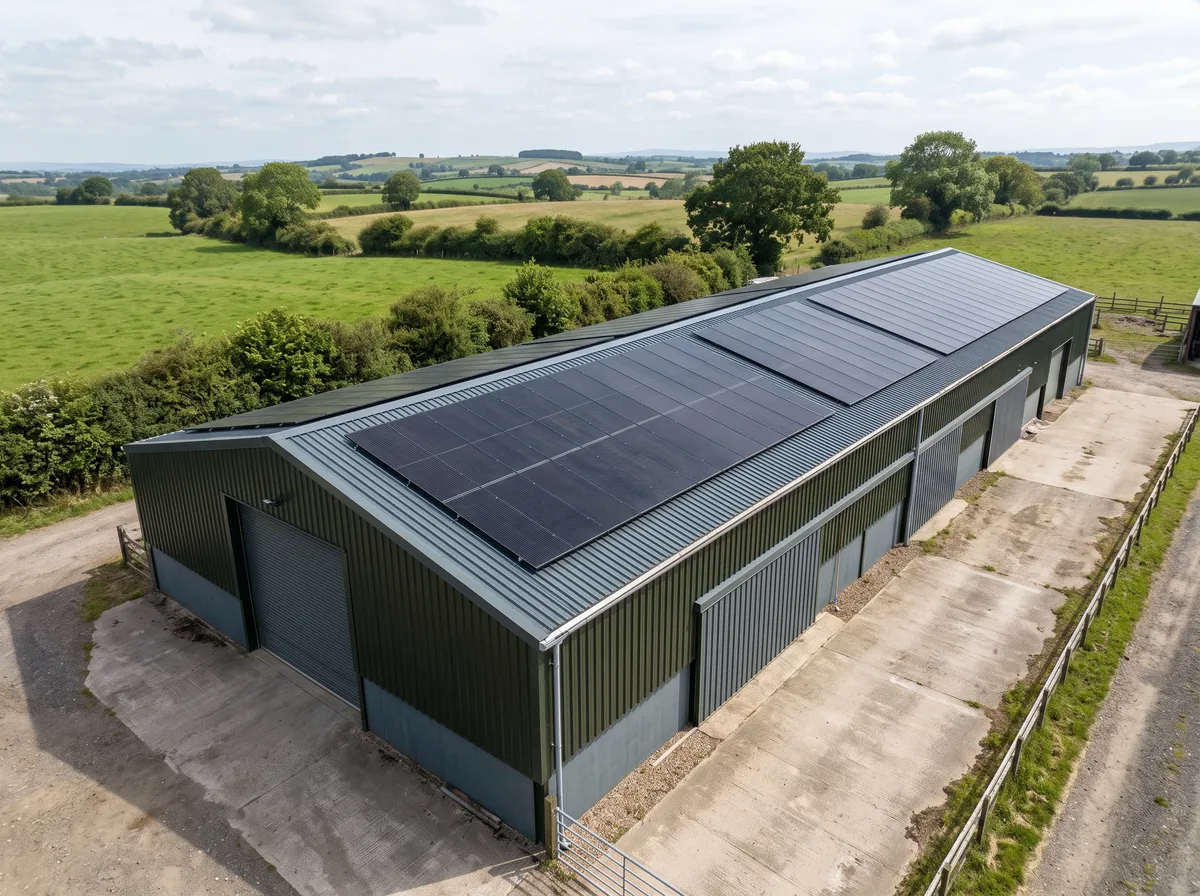
Solar Panels For Farms.
Barns, sheds and yards have large roofs and often steady daytime power use. Here is what to consider on a farm, from roof condition to export income and planning.
Takes about two minutes. Installers pay us, so it is free for you.
- Export scheme capacity limit
- 5MWSmart Export Guarantee, up to
- Annual Investment Allowance
- £1mon most plant and machinery
- Solar panel lifespan
- 25+ yrs
Source: Ofgem, Smart Export Guarantee; GOV.UK, Annual Investment Allowance; Energy Saving Trust, solar panels, 16 November 2026. Checked 17 November 2026.
Why Do Farms Fit Solar Panels?
Farm buildings are often large and unshaded, and power use can be steady across the day. Workshops, grain drying, refrigeration and irrigation can all draw power in daylight, which is when panels produce.
Our commercial solar guide covers the points that apply to any business, and this page adds what is particular to a farm.
Is My Barn Roof Suitable?
The installer needs to check the roof's condition, material and structure, its direction and shade, and whether it can carry the weight. Older farm buildings may need work first. Ask for the roof survey result in writing.
The Energy Saving Trust says homes near dusty roads or farms may need the odd clean, so ask installers how they plan for dust and how to reach the panels safely.
Source: Energy Saving Trust, solar panels, 16 November 2026.
How Much Do Farm Solar Panels Cost?
We have not found a primary-source price for farm systems, so we do not quote one. The Energy Saving Trust figure of around £7,600 is for a typical 4.5 kWp home system and does not apply to a farm roof.
Ask each installer for the price per kWp, the expected generation and how it was worked out from your usage.
Source: Energy Saving Trust, solar panels, 16 November 2026.
Can A Farm Earn From Exported Power?
Under the Smart Export Guarantee, solar PV installations of up to 5MW can be paid for exported electricity. Rates must be above zero and suppliers set their own, so compare them. You need an MCS-certified installation and a meter that records half-hourly export.
Source: Ofgem, Smart Export Guarantee; GOV.UK, Smart Export Guarantee, checked 17 November 2026.
What About VAT And Tax Relief?
The zero rate of VAT in HMRC VAT Notice 708/6 covers homes and certain charitable buildings. A farmhouse is a home, but a barn or shed is not listed, so ask your installer and accountant what applies to each building on your quote.
The Annual Investment Allowance is £1 million, and sole traders, partnerships and companies can claim it on most plant and machinery. Whether your system qualifies is a question for your accountant.
Source: HMRC VAT Notice 708/6, checked 17 November 2026; GOV.UK, Annual Investment Allowance, checked 17 November 2026.
Do I Need Planning Permission For Farm Solar?
Panels on non-domestic buildings and land may be permitted development if limits and conditions are met. In Wales, panels may project no more than 200mm from the roof or wall and must be at least 1 metre from the roof edge, and a flat roof panel may rise no more than 1 metre above it. Listed buildings need planning permission and consent.
In England, stand-alone panels on a non-domestic site are limited to the first installation, 9 square metres and 4 metres high, and at least 5 metres from the boundary. Larger ground arrays need a planning application. Check Scotland with your council.
Source: Planning Portal, stand-alone solar at a non-domestic building; gov.wales, non-domestic solar panels, checked 17 November 2026.
Should I Add A Battery Or Go Ground-Mounted?
A battery can help if your use peaks in the evening. The Energy Saving Trust says savings will not always justify the cost, so quote with and without. If a roof is not right, see ground-mounted panels. Remote sites may look at off-grid systems.
Source: Energy Saving Trust, battery storage, 6 October 2026.
Pros And Cons
Pros
- Large roofs and open space
- Daytime power use matches when panels produce
- Can earn Smart Export Guarantee income, up to 5MW
- Panels should last 25 years or more
- The £1 million Annual Investment Allowance may apply, so ask your accountant
Cons
- Older roofs may need work before panels
- Dust may mean the odd clean
- Barns and sheds are not in the zero-rate VAT notice
- Ground arrays above the planning limits need an application
- The inverter is usually replaced after around 12 years
How To Compare Quotes
Get at least three quotes and compare them line by line. Prices for the same job can differ a lot.
- The installer is MCS certified. You need an MCS-certified system to be paid for exported power under the Smart Export Guarantee.
- What is in the price: panels, inverter, any battery, scaffolding and waste removal.
- Warranties on the equipment and on the installation work, and who stands behind them.
How Switchable works
 Check. Tell us your postcode and a few details about your home. It takes about two minutes.
 Compare. Local installers who cover your area get in touch with quotes.
 Switch. Go ahead with the quote that suits you, or none at all. There is no obligation.
Switchable is free to use. Installers pay us for each introduction.
More On Solar Panels
- Solar panels guideCosts, savings and grants in one place
- Commercial Solar PanelsTax, export and planning for business roofs
- Ground-Mounted Solar PanelsPlanning limits and frame versus roof
- Solar Battery StorageWhat a battery costs and how long it lasts
- Off-Grid Solar SystemsPower without a grid connection
Solar Panels For Farms: Your Questions.
Can I put solar panels on an agricultural building?
Often yes, if the roof and structure are suitable. Panels on non-domestic buildings may be permitted development if the limits are met, and the installer will check the roof. In Wales, a listed building needs planning permission and likely listed building consent, so check the rules for your area.
Will solar panels work for my farm's power needs?
It depends on what you use and when. Panels produce in daylight, so they suit daytime loads. Ask installers to base the design on your half-hourly usage and to show the assumptions. A battery may help with evening use, but see the Energy Saving Trust caveat.
Can a farm sell power back to the grid?
Yes, through the Smart Export Guarantee for solar PV up to 5MW, according to Ofgem. You need an MCS-certified installation and a meter that records half-hourly export. Suppliers set their own rates, which must be above zero, so compare them.
Is MCS certification needed on a farm system?
For Smart Export Guarantee payments, you need an MCS-certified installation, or an equivalent. Choose an MCS-certified installer if you want export income, and ask for the certificate on completion, because it is the proof you will need when you apply to a supplier.
Do I need planning permission for ground panels on farmland?
Small arrays can be permitted development, but the limits are tight: in England, 9 square metres and 4 metres high for a stand-alone array at a non-domestic building, and only the first installation. A larger scheme needs a planning application. Ask your council early.
Get Your Free Quotes Today.
Compare quotes from installers in your area. It takes about two minutes and there is no obligation.