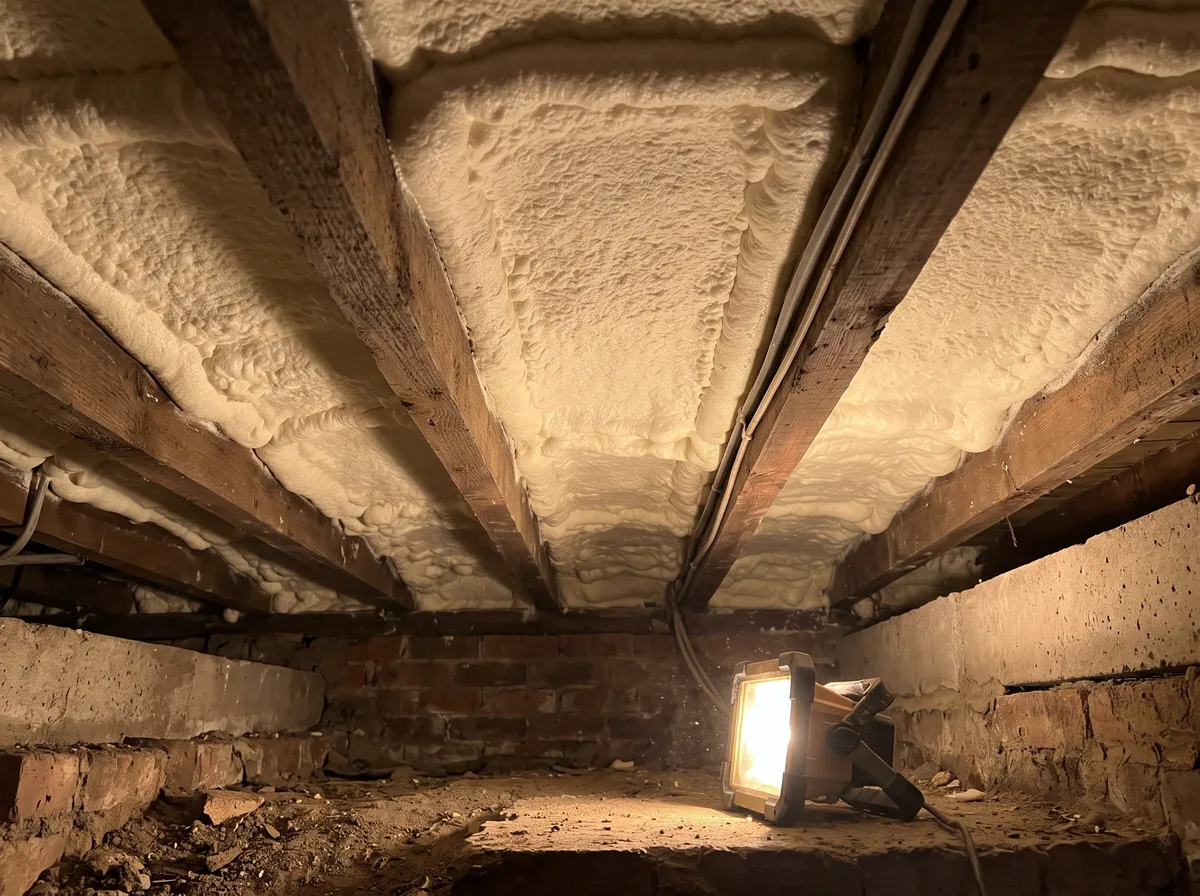
Closed Cell Spray Foam Insulation.
The denser, more effective type of spray foam. It does not let moisture pass through easily, which is both its strength and its risk, so where it goes matters.
Takes about two minutes. Installers pay us, so it is free for you.
What Is Closed Cell Spray Foam Insulation?
Closed-cell spray foam is a liquid that expands and sets into a dense foam. The Energy Saving Trust (EST) says it is a very effective insulator but does not let moisture pass through it easily. Open-cell foam is less effective and lets moisture pass.
For the full picture of spray foam, start with our spray foam insulation guide.
Source: Energy Saving Trust, spray foam insulation explained, 5 November 2026.
What Are The Risks Of Closed Cell Foam?
The moisture point is the main one. In a structure that needs to dry out, a material that does not let moisture pass can trap it. EST says poor installs of spray foam increase the risk of condensation and damp, and that spraying the underside of an old, poorly maintained roof is one of the highest-risk insulation options.
Spray foam can also be difficult to remove, and removal may mean replacing the structure it was sprayed onto. Read where not to use spray foam insulation and spray foam insulation problems.
Source: Energy Saving Trust, spray foam insulation explained, 5 November 2026.
Will Lenders Accept Closed Cell Foam?
EST says spray foam does not automatically prevent you getting a mortgage, but some lenders may ask for extra checks. RICS lists spray foam as a significant modification to the home. EST does not say closed-cell is treated differently from open-cell.
Keep the survey, specification and guarantee, and ask your lender or conveyancer early if you plan to sell.
Source: Energy Saving Trust, spray foam insulation explained, 5 November 2026.
Where Does Closed Cell Foam Suit?
It suits places where you want a high level of insulation in a thin layer, or where blocking moisture is the point. Installers also spray it onto suspended floors from underneath using a robot, as EST notes.
It is the wrong choice where a structure relies on breathing to stay dry, over existing damp, or where you may later need to inspect the timbers. For a standard loft, EST rates mineral wool as the most economical and efficient option for most lofts.
Source: Energy Saving Trust, spray foam insulation explained, 5 November 2026.
How Much Does Closed Cell Spray Foam Cost?
The Energy Saving Trust does not give a cost for spray foam, and Switchable does not publish one. Ask each installer for an itemised quote showing the area, the type of foam, the depth and any survey work.
Insulation installed in homes is zero-rated for VAT until 31 March 2027, then 5%.
Source: HMRC VAT Notice 708/6, last updated 31 January 2024.
What Should I Check Before I Book?
Ask for a survey of the space first. The installer should check ventilation and existing condensation, calculate a U-value (how much heat passes through) and explain why closed cell suits this structure.
Ask for the guarantee and paperwork in writing. EST advises caution with anyone who says you must have spray foam installed or removed. For work installed since 2020 there is a TrustMark dispute process.
Source: Energy Saving Trust, spray foam insulation explained, 5 November 2026.
I Already Have Closed Cell Foam. What Now?
Do not assume it must come out. EST points to Government advice to get a specialist surveyor to inspect it first. If you need removal, our guide on removing spray foam explains what is involved.
Source: Energy Saving Trust, spray foam insulation explained, 5 November 2026.
Are There Grants For Closed Cell Foam?
The Great British Insulation Scheme closed on 31 March 2026, and ECO4 ends on 31 December 2026 with no new scheme of the same kind to follow it. Some council and campaign pages still say they are open, so check the date before you rely on one.
In England, the Warm Homes: Local Grant may pay for insulation if eligible: homes rated EPC D to G where household income is usually £36,000 or less, or where you receive certain benefits, and where your council is taking part. In Scotland, Home Energy Scotland offers a grant of up to 75% of the cost, capped at £7,500 (£9,000 for rural homes), plus interest-free loans.
Source: GOV.UK, extending the ECO4 end date, updated 23 January 2026, GOV.UK, Warm Homes: Local Grant, checked November 2026 and Home Energy Scotland, checked November 2026.
Pros And Cons
Pros
- Very effective insulation, according to the Energy Saving Trust
- Does not let moisture pass through easily, useful where that is wanted
- Seals gaps and joints that boards and rolls can miss
- Can be sprayed from underneath a suspended floor by a robot
- A TrustMark dispute process exists for work installed since 2020
Cons
- Can trap moisture in a structure that needs to dry out
- Poor installs increase the risk of condensation and damp
- Spraying an old, poorly maintained roof is one of the highest-risk options
- Some lenders may ask for extra checks
- Difficult to remove, and removal may mean replacing the structure
How To Compare Quotes
Get at least three quotes and compare them line by line. Prices for the same job can differ a lot.
- A survey first. A good installer checks the property before quoting, including ventilation and damp.
- What is in the price: materials, depth or thickness, access, making good and waste removal.
- Guarantees on the materials and the work, and who stands behind them.
How Switchable works
 Check. Tell us your postcode and a few details about your home. It takes about two minutes.
 Compare. Local installers who cover your area get in touch with quotes.
 Switch. Go ahead with the quote that suits you, or none at all. There is no obligation.
Switchable is free to use. Installers pay us for each introduction.
More On Insulation
Closed Cell Spray Foam Insulation: Your Questions.
Why is closed cell foam linked to damp?
The Energy Saving Trust says closed-cell foam does not let moisture pass through easily. In a structure that needs to dry out, that can trap moisture against the timbers. It also says poor installs of spray foam increase the risk of condensation and damp. Used in the right place and installed well, the risk is lower.
Is closed cell foam better than open cell?
It insulates more effectively, according to the Energy Saving Trust, but it does not let moisture pass easily. Open-cell lets moisture pass but is less effective and needs a thicker layer. Neither is better everywhere, so ask installers to explain why they chose one for your structure.
Can I use closed cell foam on an old roof?
Be very careful. The Energy Saving Trust describes spraying foam onto the underside of an old, poorly maintained roof as one of the highest-risk insulation options. Get a survey, and ask the installer what lower-risk alternatives exist, such as mineral wool at joist level.
How much does closed cell spray foam cost?
The Energy Saving Trust does not give a cost for spray foam, and Switchable does not publish one. Prices depend on the area, the depth and the survey work. Ask each installer for an itemised quote, and compare what is included before you compare the totals.
Will closed cell foam affect selling my home?
It can raise questions. The Energy Saving Trust says spray foam does not automatically prevent a mortgage, but some lenders may ask for extra checks, and RICS lists it as a significant modification. Keep the survey, specification and guarantee, and ask your conveyancer early.
Get Your Free Quotes Today.
Compare quotes from installers in your area. It takes about two minutes and there is no obligation.