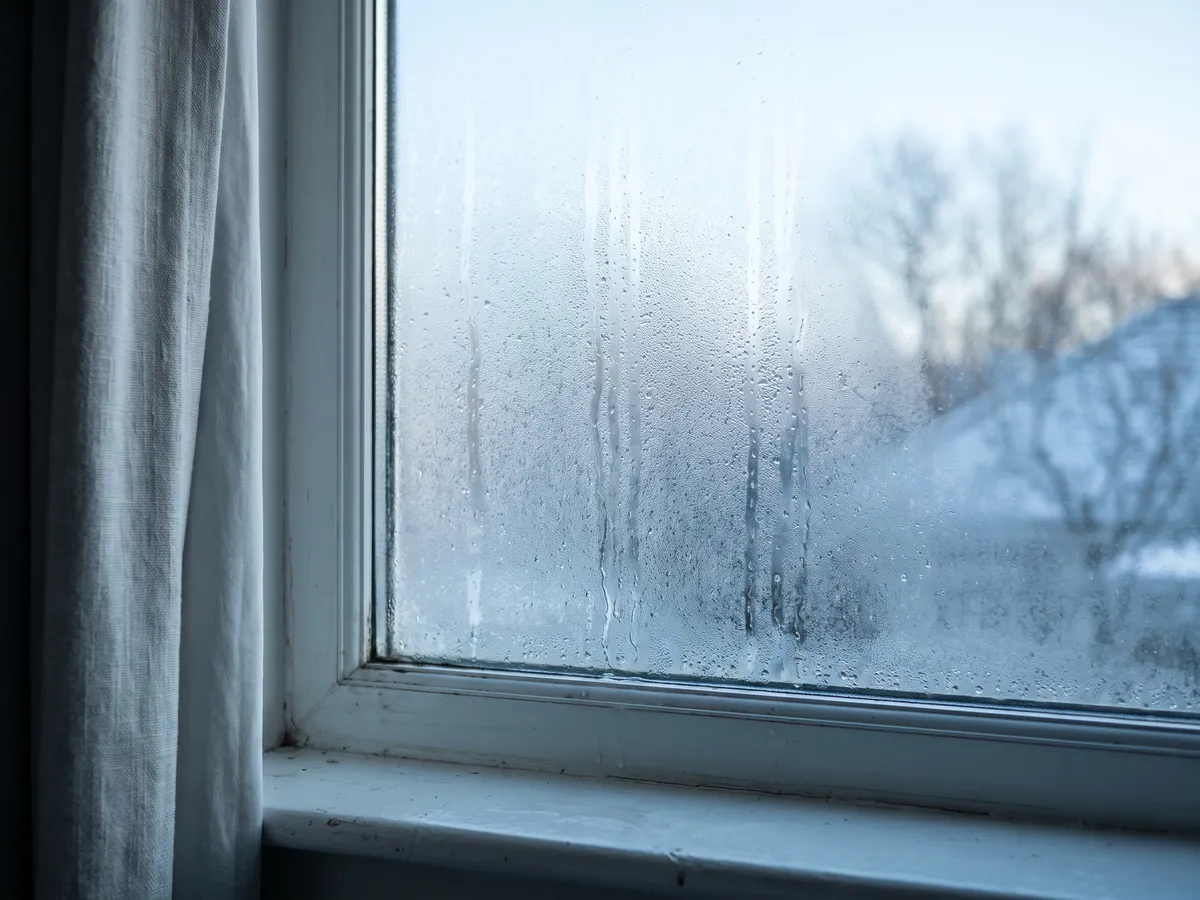
Condensation On Windows.
If your windows are misted or running with water when you wake up, this guide is for you: it explains what the water is, which kind of condensation you have and what to do before you spend money on glazing. Condensation on the inside of a window is moisture from your own home meeting cold glass, and ventilation, steady heat and less moisture fix it, not new windows. Between the panes it means the sealed unit has failed: MyJobQuote's September 2026 guide gives £55 to £145 to replace one unit. On the outside it is harmless.
Takes about two minutes. Installers pay us, so it is free for you.
- Open windows, several times a day
- 5 minuteseven in winter, Energy Saving Trust
- Run the extractor after a shower or cooking
- 15 minutesEnergy Saving Trust
- Replace one failed sealed unit
- £55 - £145MyJobQuote guide, 22 Sep 2026
- Vent area if the old windows had none
- 8,000mm²habitable room or kitchen, Approved Document F
Sources: Energy Saving Trust, how to improve your home's ventilation, last updated 26 October 2026; MyJobQuote, double glazing condensation repair cost, last updated 22 September 2026; Approved Document F, Volume 1: Dwellings, 2021 edition, paragraphs 1.34, 3.14 and 3.15; the 2026 edition repeats the 3.15 figures. Unit prices are MyJobQuote's guide figure, not Switchable's.
In short
- Where the mist sits tells you the cause: on the room side it is moisture, ventilation and heat, between the panes it is a failed seal, and on the outside it is a sign of efficient glass (Energy Saving Trust).
- To stop it: keep trickle vents open all year, open windows for 5 minutes several times a day, run extractors for 15 minutes after showers and cooking, and keep a steady background heat.
- Replacement windows in England must have trickle vents. If the old windows had none, the new ones need 8,000mm² equivalent area in habitable rooms and kitchens and 4,000mm² in bathrooms (Approved Document F).
- A failed unit is £55 to £145 to replace, or £1,400 to £2,500 for all units in a three-bed semi (MyJobQuote, September 2026). A new uPVC casement is £350 to £650. See the costs.
- GOV.UK guidance says removing surface mould will not stop it returning: the causes are ventilation, heating and building defects.
On this page (10)
Condensation On Windows: Inside, Between The Panes Or Outside
Work out where the mist sits first, because each place has a different cause and a different fix.
| Where it sits | What it usually means | What to do |
|---|---|---|
| On the room side of the glass | Moisture in the room is meeting a cold surface. It is not necessarily a problem if it clears up quickly, but if it builds up it can lead to damp and mould (Energy Saving Trust). | Ventilate, cut moisture and keep a steady heat. See the sections below. |
| Between the panes | The sealed unit has probably failed and air is getting in (Energy Saving Trust). | Ask a glazier whether replacing just the unit will do, and check any warranty first. |
| On the outside of the glass | A sign the windows are very efficient. It clears quickly and will not cause damp (Energy Saving Trust). | Nothing. |
Source: Energy Saving Trust, energy efficient windows and doors (last updated 19 November 2026, read 26 November 2026)
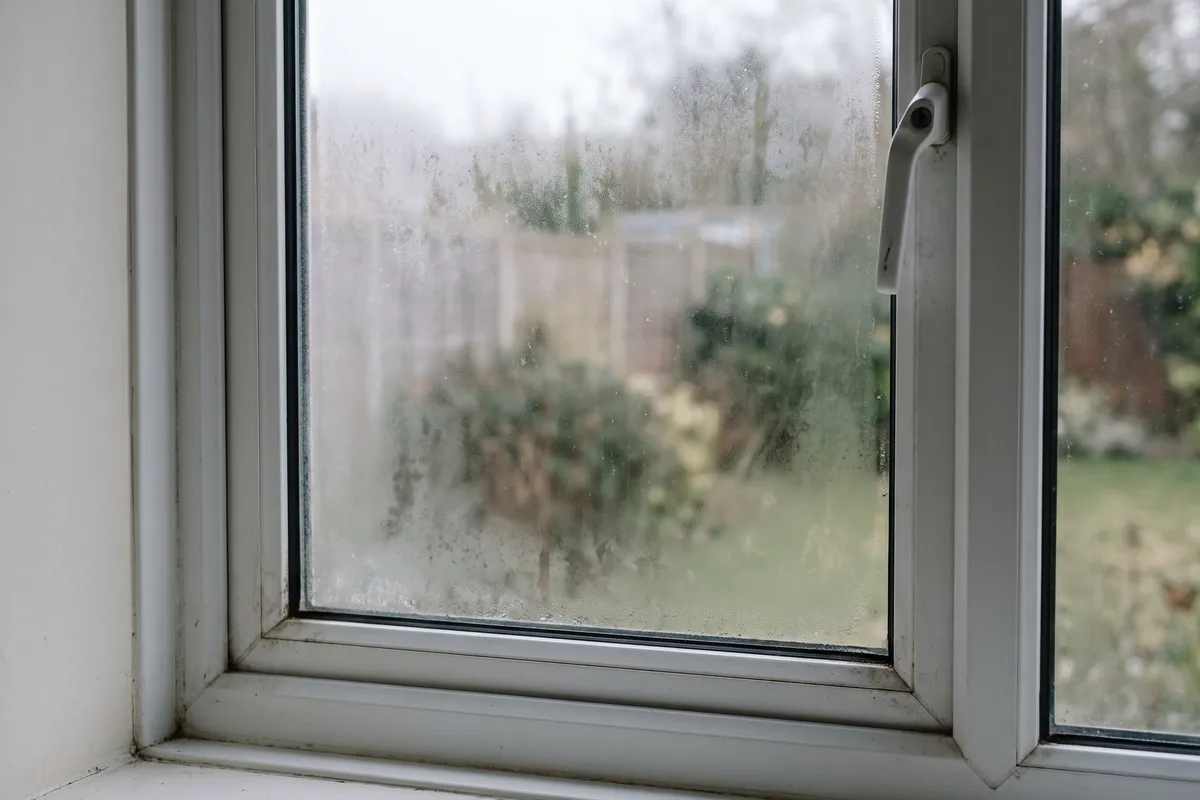
Wiping tells you which one you have: mist you can wipe off is on a surface you can reach, and mist that stays is inside the sealed unit.
Why Condensation Forms On Windows
Moisture in the air turns to droplets when it touches a cold surface, like a window, says the Energy Saving Trust. GOV.UK's guidance on damp and mould calls condensation damp the most common form of damp. It happens when moisture made inside the home cools on colder parts of the building such as window frames, corners and the backs of wardrobes.
Dew point and water vapour. Warm air holds more water vapour than cold air. When that moist air touches a surface colder than its dew point temperature, the excess moisture turns to visible liquid: water droplets on the glass. So the cause is a temperature difference plus humid air, which is why condensation on the inside of windows is worst on a cool night or in the morning, when the glass is at its coldest and the room is full of warm air from sleeping, showers and cooking. Cold spots such as window frames and the corners of walls inside collect it first.
Single glazing and double glazed windows. A single glazed window has one cold pane facing the room, so it is the most prone to condensation. A double glazed window has an air gap between two panes, which keeps the inner pane warmer, so there is less condensation on the inside of the glass; the Energy Saving Trust says energy efficient glazing reduces it. Condensation on the outer pane of a double glazed unit, on the other hand, is a sign that very little heat is escaping through the window.
Moisture made at home
Showering, cooking and drying laundry all put water into the air, and the guidance says this is unavoidable.
GOV.UK damp and mould guidance
Nowhere for it to go
If a home is inadequately ventilated, moisture in the air cannot escape and is more likely to condense.
GOV.UK damp and mould guidance
Cold surfaces
Homes that are insufficiently insulated and heated are more prone to condensation on the inside of external walls and windows.
GOV.UK damp and mould guidance
GOV.UK says it is totally unreasonable to blame damp and mould on lifestyle choices: everyday cooking, bathing and washing make moisture, so the fundamental causes are building deficiencies, inadequate ventilation, inadequate heating or poor energy efficiency. Small habit changes can still help alongside fixing the root cause.
How To Stop Condensation On Windows
The Energy Saving Trust's advice is to cut the moisture, move the air and keep rooms warm enough.
Prevent condensation day to day. To reduce condensation, remove moisture at source and improve air circulation. Extractor fans in the kitchen and bathroom take moist air out of the house, and natural ventilation through trickle vents and open windows brings drier air in. Wipe windows and sills dry in the morning so water does not sit on the frames, and keep the heating on low and steady in cold weather rather than off and on, so surfaces stay above the dew point. Drying clothes indoors puts a lot of extra moisture into the air, so use a vented dryer or an airer in a room with an open window or a dehumidifier.
Move the air
Keep trickle vents open and clear all year, even in winter. Open windows for at least five minutes, several times a day, ideally on different sides of the house. Run the bathroom extractor and cooker hood for at least 15 minutes afterwards, or open a window if you have neither.
Energy Saving Trust
Cut the moisture
Put lids on pans, dry clothes outside when you can, squeegee windows and walls after a shower, and consider a dehumidifier for rooms prone to condensation or for drying washing indoors.
Energy Saving Trust
Keep a steady heat
Rooms with the heating off or low in winter are prone to damp. Turn the heating up from time to time and improve ventilation, but running it all day just to stay dry is not a sensible fix.
Energy Saving Trust
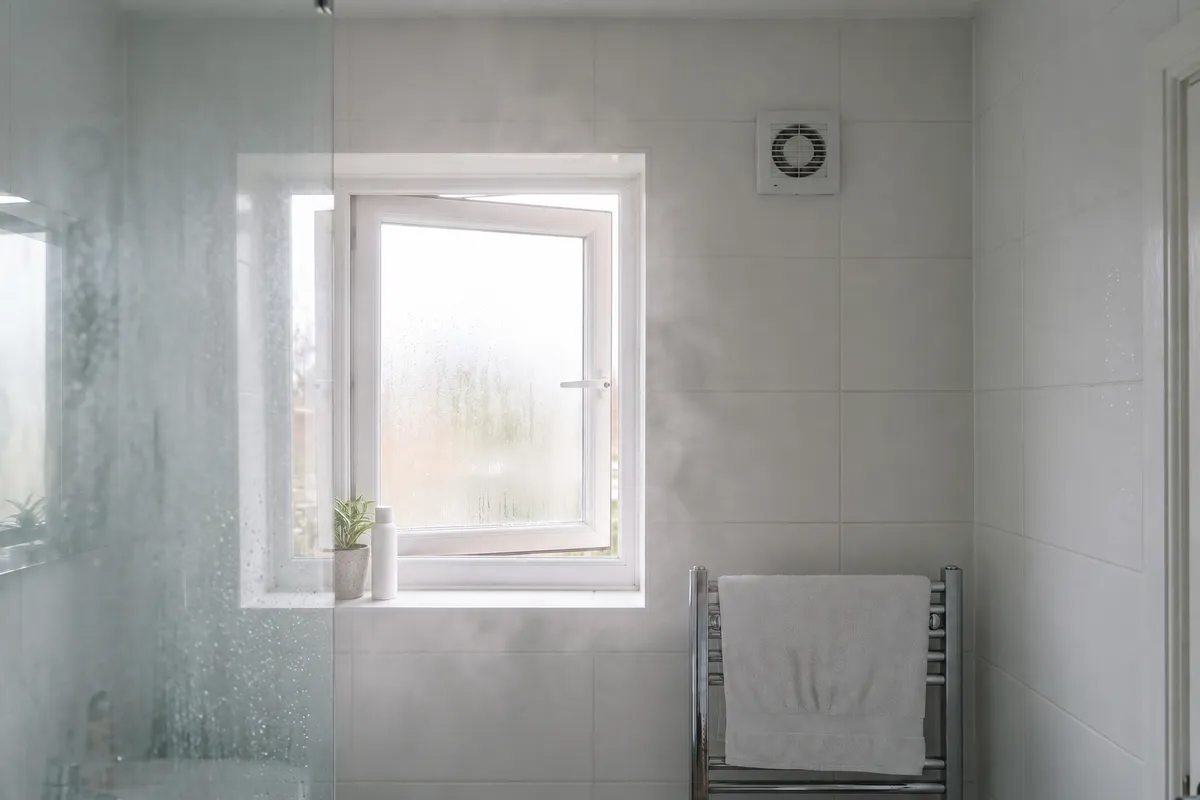
GOV.UK adds that keeping windows in the vent position, partly open but locked, can help where security is a worry, as can closing internal doors when you cook or shower and leaving a gap between furniture and external walls.
Source: Energy Saving Trust, how to improve your home's ventilation, last updated 26 October 2026; Energy Saving Trust, how to get rid of damp, last updated 22 May 2026.
Trickle Vents And Approved Document F
A trickle vent is a small controllable slot, usually at the top of a window frame, that lets in a steady small amount of air. The Energy Saving Trust says to keep them open all year. Approved Document F says they are intended to normally be left open and sit at least 1,700 mm above the floor, which limits cold draughts.
| If the old windows | What the replacement windows need |
|---|---|
| Had trickle vents | Vents no smaller than the originals, controllable by the occupant or automatically. |
| Had none | Vents of at least 8,000mm² equivalent area in habitable rooms and the kitchen and 4,000mm² in a bathroom, or another route that leaves ventilation no worse than before. |
| Position | At least 1,700 mm above floor level. |
Source: Approved Document F, Volume 1: Dwellings, 2021 edition, paragraphs 1.34, 3.14 and 3.15; the 2026 edition repeats the 3.15 figures.
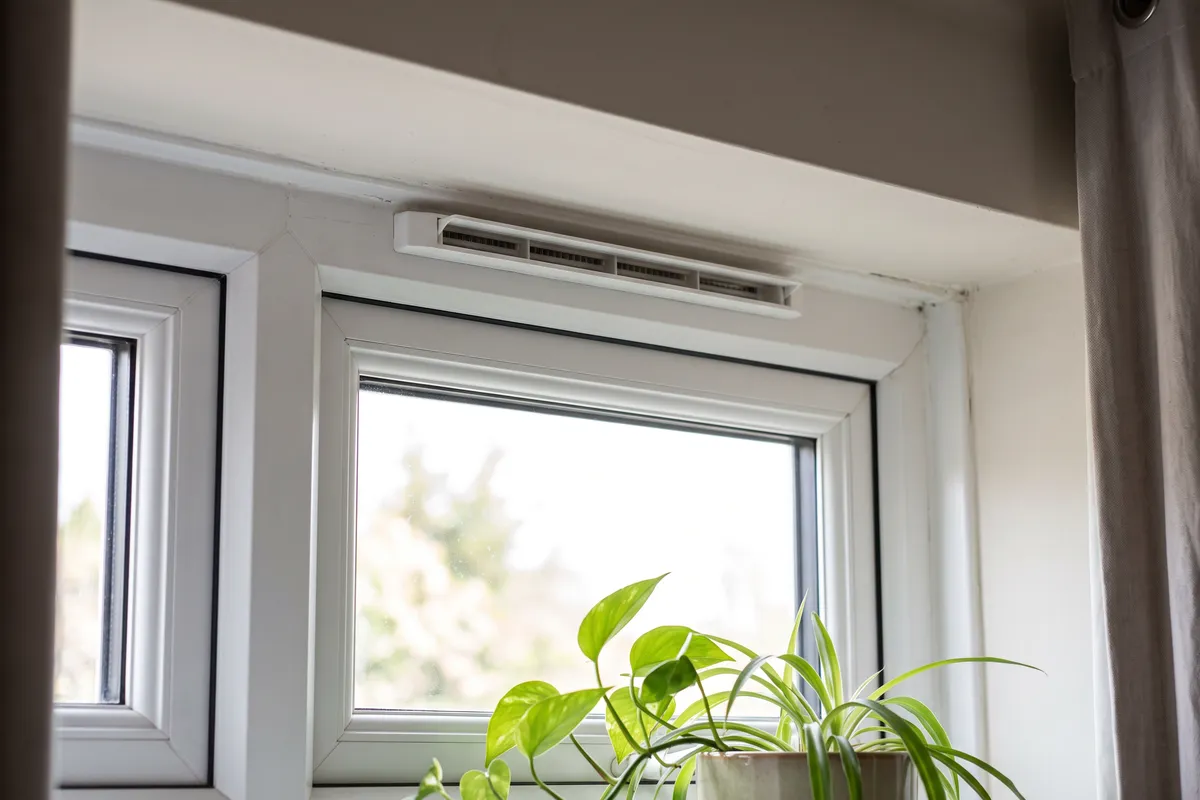
GOV.UK's damp guidance says all replacement windows are required to have trickle vents under building regulations, and that they should be controllable rather than permanently open, because permanently open ones encourage people to block them. Do not drill one into an existing frame: the Energy Saving Trust says that risks damaging the window, and a ventilation specialist can fit a wall vent instead.
When Condensation Means A Failed Sealed Unit
A double glazed unit is sealed so that nothing gets between the panes. When the seal fails, air gets in, which the Energy Saving Trust says reduces the window's effectiveness. It lists condensation between the panes, discolouration, draughts and difficulty opening as signs it may be time to replace, and says it is possible to replace the panes rather than the whole window.
| Option | Guide | Guide figure |
|---|---|---|
| Replace one unit, small window | MyJobQuote (22 Sep 2026) | £55 to £75 |
| Replace one unit, large window | MyJobQuote (22 Sep 2026) | £115 to £145 |
| Specialist resealing | MyJobQuote (22 Sep 2026) | £50 to £100 a window, and it may not last as long |
| Every unit in a 3-bed semi | MyJobQuote (22 Sep 2026) | £1,400 to £2,500 |
| New uPVC casement window instead | MyJobQuote (22 Sep 2026) | £350 to £650 |
| Replace a failed unit, supplied and fitted | Checkatrade (cost table May 2024, older) | £55 to £300, average £100 |
Source: MyJobQuote, double glazing condensation repair cost, last updated 22 September 2026; Checkatrade, window glass replacement cost, cost table dated May 2024 (page updated February 2025). Guide figures, not Switchable's, and not averaged.
Check the paperwork first
Your original installation paperwork may include a guarantee that covers a failed sealed unit. Check it before you pay for a replacement.
Switchable
Ask for the glass spec
A new unit is a chance to ask for the same or better glass than the old one, so ask for the specification in writing.
Switchable
Say eight windows have failed in a semi. MyJobQuote's labour table counts 8 to 10 windows for a 3-bed semi, so eight is reasonable. Replacing the units costs £1,400 to £2,500 on its figure. Eight new uPVC casements at £350 to £650 each would be £2,800 to £5,200 (our arithmetic), so units cost about half, provided the frames are sound.
New units only make sense in a frame that is still sound: if the frame is damaged or rotten, replacing the whole window is the safer spend, and ask the installer to confirm the frame before you agree.
Source: MyJobQuote, double glazing condensation repair cost, last updated 22 September 2026; MyJobQuote, new windows cost guide, last updated 20 October 2026. Arithmetic is Switchable's.
Will New Windows Stop Condensation?
Sometimes, and sometimes they make it worse. The Energy Saving Trust says energy efficient glazing reduces condensation on the inside of windows. But new windows are more airtight than old ones, and GOV.UK warns that some energy efficiency work reduces ventilation, so ventilation has to be checked alongside it.
Worth it when
The glass is old, single glazed or has failed seals, so the inside pane stays cold or air is getting into the unit.
Energy Saving Trust
Risky when
Tight new windows go in with no ventilation. The Energy Saving Trust says not to add draught proofing to a room that lacks ventilation or already has condensation, and to ask installers what ventilation they include.
Energy Saving Trust
Triple glazing
It keeps the inside pane warmer, but it does not remove the moisture. See our triple glazing guide for the sums.
Switchable
Damp, Mould And Landlords: What The Government Guidance Says
GOV.UK's guidance, published in 2023 after the coroner's report on the death of two-year-old Awaab Ishak and updated on 1 April 2026, is written for landlords and says it may also interest owner-occupiers and tenants. Its main points are below.
What untreated condensation can damage. Excessive condensation that is left to sit can lead to mould growth and damp patches around the window, and standing water can damage window frames and wood trim over time. Mould spores affect the airways, which is why the guidance treats persistent condensation as a damp problem and not a cosmetic one. Wipe it, use a mould and mildew spray on small areas as the guidance says, and fix the cause.
Fix the cause, not just the mould
Simply removing surface mould will not prevent it reappearing. Landlords should tackle building deficiencies, inadequate ventilation and condensation.
GOV.UK
Cleaning small patches
Most tenants could reasonably be expected to remove condensation and very small amounts of mould with a mould and mildew cleaner, in preference to bleach. Larger areas should be dealt with by professionals.
GOV.UK
Windows are controlled work
Replacing windows, like work on heating and ventilation systems, must comply with building regulations. A landlord can use a tradesperson on a competent person scheme.
GOV.UK
Health and the law
Damp and mould mainly affect the airways and lungs. Rented homes must be free of damp and mould hazards so serious that the home is not reasonably suitable to live in, under the Landlord and Tenant Act 1985 as amended in 2018.
GOV.UK
If you rent and the condensation keeps coming back despite ventilating, the guidance puts the underlying problem on the landlord. This is a summary of official guidance, not legal advice.
The Bottom Line
Condensation on the room side of the glass is a moisture and ventilation problem before it is a window problem: keep trickle vents open, open windows for five minutes a few times a day, run extractors for 15 minutes after showers and cooking, and keep a steady heat. Between the panes, the sealed unit has failed, and replacing it costs £55 to £145 a unit in MyJobQuote's September 2026 guide, about half the price of new windows if the frames are sound.
If you are replacing windows, get the trickle vent size written into every quote, because new windows are tighter than old ones. Switchable is independent: it is not paid by any window maker for this page, and how we review explains how we write our guides.
Compare window and door quotesSources
- GOV.UK, damp and mould: understanding and addressing the health risks for rented housing providers, published 7 September 2023, updated 1 April 2026
- Energy Saving Trust, how to get rid of damp
- Energy Saving Trust, how to improve your home's ventilation
- Energy Saving Trust, energy efficient windows and doors (last updated 19 November 2026, read 26 November 2026)
- GOV.UK, Approved Document F (Ventilation), 2021 and 2026 editions
- Planning Portal, building regulations for doors and windows
- GOV.UK, competent person schemes
Checked 26 November 2026.
How To Compare Quotes
Get at least three quotes and compare them line by line. Prices for the same job can differ a lot.
- A price for each window and door. One total hides where the money goes, so ask for every window and door on its own line.
- The same specification on every quote: frame material, glass, energy rating, and whether the old frames are removed and made good.
- A competent person scheme certificate. Ask whether the installer is registered with Fensa, Certass or another scheme and will certify the work, and whether the 20% VAT is in the price.
How Switchable works
 Check. Tell us your postcode and a few details about your home. It takes about two minutes.
 Compare. Local installers who cover your area get in touch with quotes.
 Switch. Go ahead with the quote that suits you, or none at all. There is no obligation.
Switchable is free to use. Installers pay us for each introduction.
More On Windows And Doors
- Windows and doors guideCosts, savings and grants in one place
- Double Glazing CostUnits, triple and secondary glazing prices
- New Windows CostPer-window prices by material, from named guides
- New Windows Cost CalculatorRough range for your windows, from named guides
- uPVC vs Aluminium WindowsuPVC or aluminium windows: frames, energy rating, lifespan and price
Condensation On Windows: Your Questions.
Why is there condensation on the inside of my windows?
Moisture in the room is meeting cold glass. The Energy Saving Trust says this is not necessarily a problem if it clears quickly, but it is a sign to ventilate, cut moisture and keep the room warm enough.
How do I stop condensation on windows?
The Energy Saving Trust says to keep trickle vents open, open windows for at least five minutes several times a day, run extractors for at least 15 minutes after showers and cooking, put lids on pans and dry clothes outside where you can. A steady background heat helps too.
What does condensation between the panes mean?
The sealed unit has probably failed and air is getting in, according to the Energy Saving Trust. It is possible to replace just the unit rather than the whole window if the frame is sound.
How much does it cost to fix condensation between double glazing?
MyJobQuote (September 2026) gives £55 to £145 to replace one unit and £1,400 to £2,500 for every unit in a 3-bed semi. Checkatrade's older table gives £55 to £300 a unit with an average of £100. Resealing is £50 to £100 but may not last as long.
Is condensation on the outside of windows a problem?
No. The Energy Saving Trust says it is a sign the windows are very efficient, and it clears quickly without causing damp.
Do trickle vents have to be fitted to replacement windows?
Yes, in England. GOV.UK says building regulations require trickle vents in all replacement windows. If the old windows had none, Approved Document F asks for 8,000mm² equivalent area in habitable rooms and kitchens and 4,000mm² in bathrooms, or ventilation no worse than before.
Should I keep my trickle vents open in winter?
Yes, the Energy Saving Trust says to keep them open all year, even in winter, and only close them briefly if outdoor pollution is high. If traffic noise is the worry, vents with added soundproofing are available.
Does mould around windows mean I need new windows?
Not necessarily. GOV.UK says removing surface mould will not stop it returning, and the cause is usually ventilation, heating or building defects. New windows can help if the old ones are failing, but they need ventilation too.
Does double glazing stop condensation?
It reduces condensation on the inside because the inner pane stays warmer, and the Energy Saving Trust says energy efficient glazing helps. It does not remove the moisture in the room, so ventilation and heat still matter, and triple glazed windows keep the inside pane warmer again but have the same limit.
Why do my windows have condensation in the morning?
Overnight the glass is at its coldest and the room fills with warm, humid air from breathing and any evening showers or cooking. The moist air meets the cold surface and condenses. Opening a window or trickle vent and wiping the glass dry will clear it.
Does condensation damage windows?
It can, if it is left to sit. Standing water can damage window frames and wood trim, and persistent damp can lead to mould. Wipe it away each morning and tackle the ventilation and heating so it does not return.
Get Your Free Quotes Today.
Compare quotes from installers in your area. It takes about two minutes and there is no obligation.