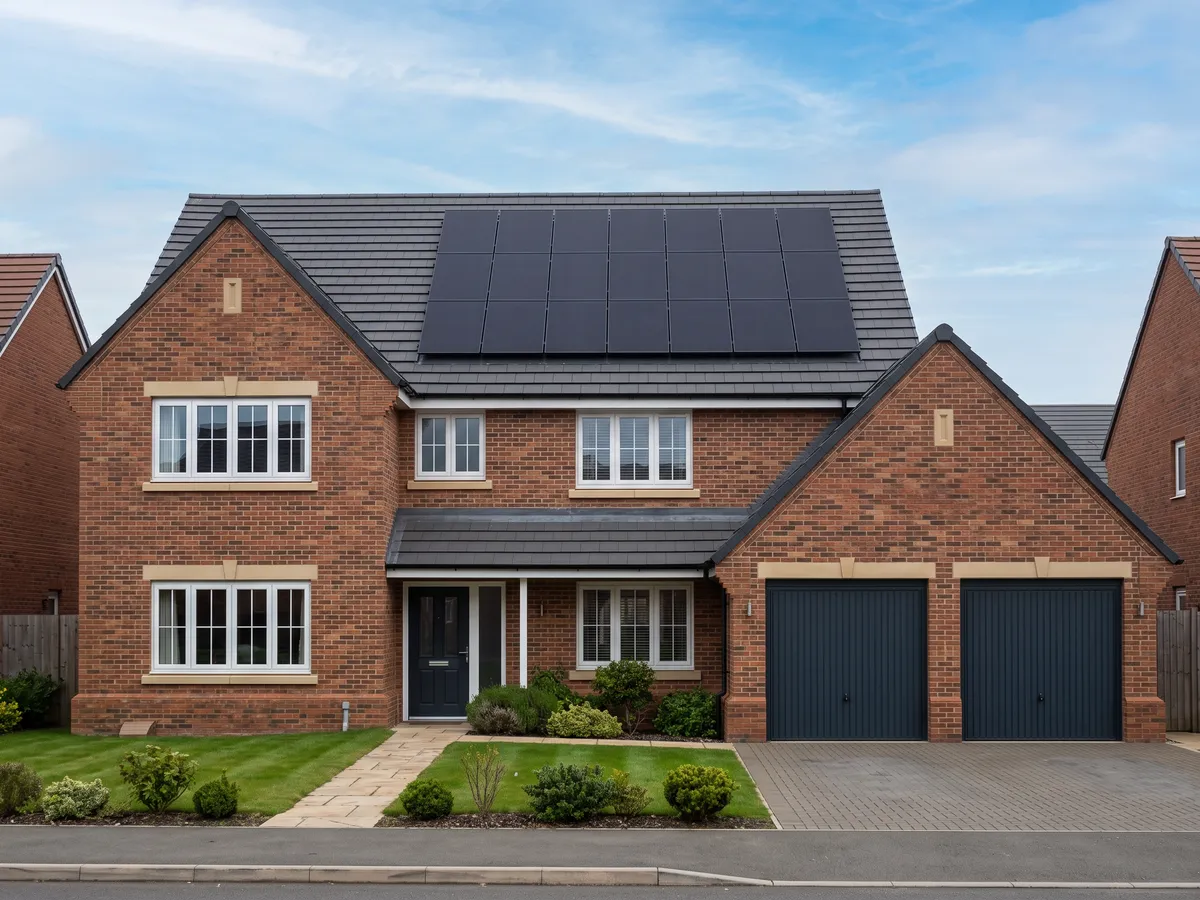
10kW Solar Systems.
A 10kW system is about twice the size of a typical UK home array: roughly 24 panels and 50 square metres of roof, producing about 7,000 to 10,400kWh a year depending on region and roof direction. The government's installer data points to between about £12,000 and £15,500 for a system this size. The grid rules change at this size too: a single-phase inverter above 3.68kW needs network operator approval before it is switched on.
Takes about two minutes. Installers pay us, so it is free for you.
- Panels at 430W each
- 24or 25 at 400W, about 47 to 50 square metres
- Yearly output, modelled
- 7,000 to 10,400kWhPVGIS, depends on region and roof direction
- Official median installed cost, 4 to 10kW
- £1,546 per kWDESNZ, 2025/26 MCS installs, about £15,500 for 10kW
- Per phase, above which you apply to the network first
- 3.68kW16 amps at 230 volts
Source: DESNZ, Solar PV cost data, published 28 May 2026 (TIC basis); European Commission PVGIS 5.3; BestBuilders, 7 September 2026; National Grid, G99 connection procedures, read 26 November 2026.
In short
- A 10kW system is about 24 panels of 430W (25 at 400W) and needs roughly 47 to 50 square metres of clear roof.
- On the European Commission's PVGIS model, 10kW makes about 8,900 to 10,400kWh a year facing south and about 7,000 to 8,300kWh facing east or west, three to four times a typical home's use.
- Official installer data gives a median of £1,546 per kW for 4 to 10kW systems and £1,204 per kW for 10 to 50kW, so £12,000 to £15,500 for 10kW. Price guides range from £14,000 to £19,500.
- A single-phase inverter above 3.68kW needs network operator approval first (G99). A three-phase 10kW inverter is about 14.5A per phase, inside the simpler G98 route. See the rules.
- It suits a large roof and a big daytime or electric-vehicle load. Most of the output of a normal-sized household would be exported.
On this page (12)
What Is A 10kW Solar System?
The 10kW figure is usually the peak output of all the panels together, written kWp. The Energy Saving Trust, quoted by MoneySavingExpert, puts the typical home array at 4.5kWp, so 10kW is about 2.2 times that (10 divided by 4.5, our arithmetic). Some quotes use "10kW" for the inverter instead, and the two are not the same: an inverter is the box that turns the panels' output into household current, and it can be smaller than the array. The grid rules below follow the inverter's rating, not the panels'.
How Many Panels And How Much Roof Does 10kW Need?
Divide 10,000 watts by the rating of each panel and round up. Panels of 400W to 450W are common now, so the answer is 23 to 25.
| Panel rating | Panels for 10kW | Roof area, at about 2 square metres each |
|---|---|---|
| 400W | 25 | About 50 square metres |
| 430W | 24 | About 47 to 50 square metres |
| 450W | 23 | About 46 square metres |
Source: BestBuilders, solar panels cost by system size, 8 September 2026 (about 24 panels, about 50 square metres) and BestBuilders, 7 September 2026 (23 to 24 panels of 430W, about 47 square metres). The 400W and 450W rows are our arithmetic, using the area per panel those figures imply.
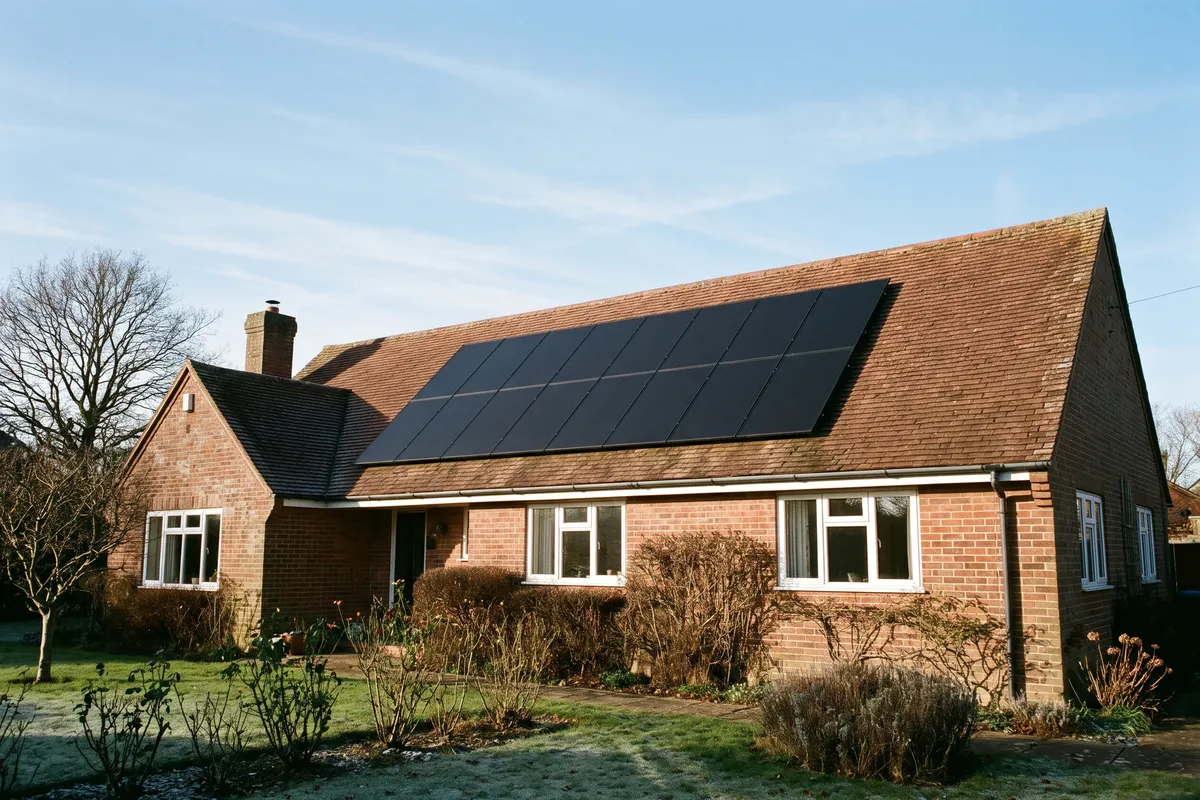
That is a lot of roof. A typical semi-detached slope rarely has 50 square metres clear of chimneys, dormers and shade, so a 10kW array often splits across two roof planes, for example east and west. That is allowed, though each direction produces less, as the next table shows.
Roof angle matters less than direction. In our PVGIS runs on the solar panel output guide, any pitch from 20° to 60° stays within about 5% of the best angle, so a standard pitched roof rarely rules itself out. On a split roof, ask whether the quote uses a string inverter or a microinverter: a string inverter links the panels in series, so a shadow on one panel can pull down the others, while a microinverter converts at each panel, which can suit an east and west split or a roof with some shade.
How Much Electricity Does A 10kW System Produce In The UK?
We modelled it with PVGIS, the European Commission's solar tool, for a 10kW array at a 35 degree tilt with no shade and 14% system losses. This is a model, not a promise: installers use their own method and quote lower figures, and shade, dirt and ageing all trim the result.
| City | Facing south | Facing east | Facing west |
|---|---|---|---|
| London | 10,200 | 8,200 | 7,900 |
| Cardiff | 10,400 | 8,100 | 8,300 |
| Edinburgh | 9,000 | 7,100 | 7,000 |
| Manchester | 8,900 | 7,200 | 7,000 |
Source: European Commission PVGIS 5.3, SARAH3 solar data 2005 to 2023, 10kW of panels at 35 degrees, 14% system losses, no shading, run 26 November 2026 and rounded to the nearest 100. BestBuilders, 7 September 2026, gives 8,500 to 9,500kWh for a 10kW system, which sits inside this range.
Compare that with demand. MoneySavingExpert quotes average use of about 7.4kWh a day, around 2,700kWh a year, so a south-facing 10kW array makes 3.3 times that in Manchester and 3.8 times in London (our arithmetic). Unless you use a lot in the daytime, most of the output is exported. Exports of up to 30kW can be approved for a Smart Export Guarantee tariff through your energy supplier, and export rates vary by supplier, so we have not quoted one.
Source: MoneySavingExpert, plug-in solar panels, updated 20 October 2026, for average use; Electricity North West for the export rule, read 26 November 2026.
How Much Does A 10kW Solar System Cost?
The strongest evidence is the government's own installer data, because it comes from thousands of real MCS installations. Price guides give a wider spread, so each figure below is labelled with its source and date and none is averaged.
| Source and date | Figure | What it means for 10kW |
|---|---|---|
| DESNZ Solar PV cost data, 28 May 2026 (MCS installs in Great Britain, 2025/26) | Median £1,546 per kW for 4 to 10kW; £1,204 per kW for 10 to 50kW | About £15,500 at the first rate and £12,000 at the second (our arithmetic). Includes equipment, installation, connection and VAT where it applies; excludes batteries |
| BestBuilders, 8 September 2026 | £14,000 to £19,500 | About 24 panels, about £1,675 per kW, including 0% VAT, scaffolding, inverter and MCS certification |
| BestBuilders, 7 September 2026 (another page) | £8,300 to £10,500 | We do not rely on this. It contradicts the same publisher's other page and sits below even the official 10 to 50kW median |
| MoneySavingExpert, 25 November 2026, citing the Energy Saving Trust | About £7,600 for a 4.5kWp system | About £1,690 per kWp (our arithmetic), for scale |
Source: DESNZ, Solar PV cost data 2025/26, total installed capacity basis, workbook published 28 May 2026; BestBuilders; BestBuilders; MoneySavingExpert. A 10kW system sits at the top of the 4 to 10kW band, so the true figure falls between the two official rates.
So, on the official data, plan on about £12,000 to £15,500 before a battery. BestBuilders adds that a consumer unit upgrade (£300 to £600) and a three-phase supply upgrade are usually extra. Home solar installed in residential accommodation is zero-rated for VAT until 31 March 2027, after which the rate reverts to 5%, according to HMRC, and the same notice covers batteries installed in a home. The installation cost is only part of the picture: ask each installer to separate the price of the panels, the inverter and any solar batteries, so you can compare like with like.
Source: HMRC VAT Notice 708/6, read 26 November 2026; BestBuilders, 7 September 2026 for the unit upgrade price.
What Are The Grid Connection Rules For A 10kW System?
This is where 10kW differs from a 4kW system. The rules follow the inverter's continuous AC rating, summed across everything at the property, not the size of the array. Up to 16 amps per phase, which is 3.68kW on a single phase, a system can use the G98 route: the installer connects it and files the paperwork within 28 days. Above that, the G99 route applies and the installer applies first.
| Inverter | Route | What happens |
|---|---|---|
| Single phase, up to 3.68kW | G98 | Connect first and notify within 28 days. The inverter should be type tested and listed on the Energy Networks Association's register |
| Single phase, above 3.68kW, such as a 10kW hybrid | G99 | Apply first with form A1-1 and a single line diagram. Do not switch on until the commissioning documents are approved. A simpler process applies up to 17kW |
| Three phase, up to 11.04kW | G98 | A three-phase 10kW inverter is about 14.5A per phase (10,000 divided by 3 divided by 230, our arithmetic), so it can use G98 if type tested. It needs a three-phase supply |
| Three phase, above 11.04kW | G99 | A simpler process applies up to 50kW |
Source: National Grid, G98 connection procedures; National Grid, G99 connection procedures; Electricity North West, G99, read 26 November 2026. The Energy Networks Association's own pages blocked our access, so this rests on these network operators' pages. Your network operator's own page governs your connection.
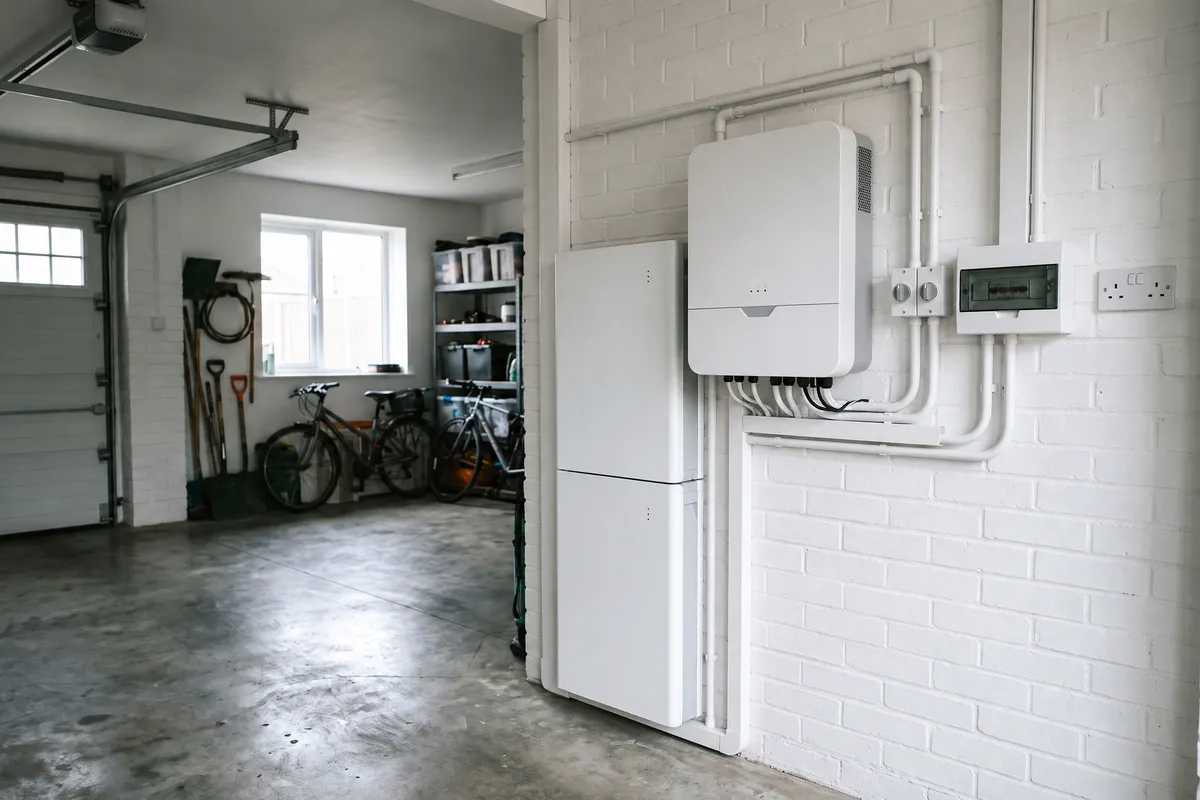
Two practical points. If other small generators are within 500 metres, National Grid says you must apply first even for a G98-sized system. And because the rating that counts is the inverter's, an installer can fit 10kW of panels to a smaller inverter to stay in a simpler route. That is a legitimate design choice, but it caps what you can use at once, so ask them to show you the numbers.
What Affects The Output And Cost Of A 10kW Solar Panel System?
Four factors decide what a 10kW solar panel system makes and costs. Location and roof orientation set the output: a south-facing roof makes more power than an east or west one, and a home in the south-west makes more energy than one in Scotland. Roof space sets the size you can fit, and with less space, higher efficiency panels give more power from the same area. Installation complexity moves the overall cost, because scaffolding, a consumer unit upgrade or a three-phase supply are extra lines. And your energy usage decides the value: the same system saves more on energy bills where daytime use is high, because excess energy that you cannot use is exported instead.
This guide covers grid-connected systems, not off grid ones. The benefits are lower electricity bills and export income, with a battery capacity you choose to match your evening use. Ask installers which factors they have priced in, so the quotes describe the same system and you can compare the investment fairly.
Who Does A 10kW Solar System Suit?
On the published figures, 10kW suits a home with a large, unshaded roof and a big daytime load: several people at home, a home office, an electric car charged by day, or a heat pump. It can also suit a larger property where the roof is simply big and a smaller array would leave space unused. For a household using the average 2,700kWh a year, a 10kW array would export most of its output, and a smaller system such as our 3kW guide describes may cost less per kilowatt-hour you use. Ask installers to model your own usage at more than one size.
The payback period is the installation cost divided by what the system saves you each year on electricity bills plus any export income, so it depends heavily on how much of the output you use yourself. A 10kW array with a large daytime load pays back differently from one that exports most of its output, and a battery storage unit lets you keep more of the excess electricity for the evening at an extra cost. Ask installers to show the yearly saving, the export income and the electricity price they assumed, and to rerun the sum with and without a battery.
10kW Solar System Pros And Cons
What counts in its favour
- A south-facing array produces three to four times a typical home's yearly use on the modelled figures.
- The official median cost per kW falls for larger systems: £1,204 per kW for 10 to 50kW against £1,546 for 4 to 10kW.
- Suits a large roof and a high daytime or electric-vehicle load.
- Zero-rated for VAT until 31 March 2027.
- Exports of up to 30kW can earn a Smart Export Guarantee payment through your supplier.
What to weigh up
- Needs about 47 to 50 square metres of clear roof, which many roofs lack.
- A single-phase inverter above 3.68kW needs network operator approval before switching on.
- Most of the output is exported unless your daytime use is high.
- Costs run to between about £12,000 and £15,500 before a battery, with possible extras for the consumer unit or a three-phase supply.
- Modelled output is not guaranteed, and east or west roofs produce about 20% less.
What Should I Check In A 10kW Quote?
Get at least three quotes from MCS-certified installers and ask each for an itemised quote: the number and rating of the panels, the inverter make, model and AC rating, the price per kW, the roof area used and the expected yearly output with the method behind it. Also ask which grid application they will make and how long your network operator is taking, whether a consumer unit or supply upgrade is included, and the warranty years on each part. Switchable compares and introduces: tell us about your home and local installers send you their prices, free and without obligation. We are independent of every maker and price guide named here and are not paid by them for this page; our method is on the how we review page.
Ask about maintenance too: what servicing the installer recommends, the inverter warranty and who attends if it fails. Keep any checking to what you can see safely from the ground, such as the monitoring app and the inverter display, and leave roof work and electrical checks to the installer.
The Bottom Line
A 10kW system is a big install: about 24 panels, 47 to 50 square metres of roof, and on the official data about £12,000 to £15,500 before a battery, producing, facing south, three to four times what a typical home uses. It makes sense where the roof is large and the daytime load is heavy, and it brings a grid approval step if the inverter is single phase above 3.68kW.
Ask for the inverter rating, the grid application, the modelled output and an itemised price at more than one size, and read our solar panel output guide before you sign.
Compare solar quotesSources
- European Commission, Photovoltaic Geographical Information System (PVGIS)
- HMRC VAT Notice 708/6, read 26 November 2026, batteries installed in a home
Checked 26 November 2026.
How To Compare Quotes
Get at least three quotes and compare them line by line. Prices for the same job can differ a lot.
- The installer is MCS certified. You need an MCS-certified system to be paid for exported power under the Smart Export Guarantee.
- What is in the price: panels, inverter, any battery, scaffolding and waste removal.
- Warranties on the equipment and on the installation work, and who stands behind them.
How Switchable works
 Check. Tell us your postcode and a few details about your home. It takes about two minutes.
 Compare. Local installers who cover your area get in touch with quotes.
 Switch. Go ahead with the quote that suits you, or none at all. There is no obligation.
Switchable is free to use. Installers pay us for each introduction.
More On Solar Panels
- Solar panels guideCosts, savings and grants in one place
- 3kW Solar Panel SystemsHow a 3kW array compares and pays back
- Solar Battery CostWhat a battery costs by size, and what changes the price
- How Much Electricity Does A Solar Panel Produce?kWh per panel and per 4kW system, by region, roof direction, pitch and month
- Best Solar Panels UKHow to choose, and six home panels compared from their datasheets
10kW Solar Systems: Your Questions.
How many solar panels do I need for 10kW?
Divide 10,000 watts by the rating of each panel. With 400W panels you need 25, with 430W panels 24 and with 450W panels 23. Your installer will confirm what fits on your roof.
How much does a 10kW solar system cost in the UK?
DESNZ's 2025/26 installer data gives a median of £1,546 per kW for 4 to 10kW systems and £1,204 per kW for 10 to 50kW, which is about £12,000 to £15,500 for 10kW before a battery. BestBuilders gave £14,000 to £19,500 on 8 September 2026.
How much electricity does a 10kW system generate?
On the European Commission's PVGIS model, a south-facing 10kW array at 35 degrees makes about 8,900 to 10,400kWh a year across London, Cardiff, Edinburgh and Manchester, and about 7,000 to 8,300kWh facing east or west. Real output depends on shade and your installer's own method.
How much roof space do I need for 10kW?
Roughly 47 to 50 square metres of clear roof, based on BestBuilders' figures for 23 to 24 panels. That is more than many roofs have free, so the array may need to split across two roof planes.
Do I need permission from my network operator for 10kW?
If the inverter is single phase and above 3.68kW, yes: your installer applies under G99 first, and the system is not switched on until the commissioning documents are approved. A type-tested three-phase 10kW inverter is about 14.5A per phase and can use the simpler G98 route, with notification within 28 days.
Is a 10kW system too big for a house?
It can be, if your use is average. A typical home uses about 2,700kWh a year and a south-facing 10kW array makes three to four times that, so most would be exported. It suits a big roof and a heavy daytime or electric-vehicle load.
Is VAT charged on a 10kW solar system?
HMRC says home solar installed in residential accommodation is zero-rated until 31 March 2027, after which the rate reverts to 5%. Check the treatment with each installer.
What is the payback period on a 10kW solar system?
It is the installation cost divided by the yearly saving on your electricity bills plus any export income. That depends on how much of the output you use at home, so ask each installer to show the saving, the export income and the electricity price assumed rather than relying on one headline figure.
Should I add a battery to a 10kW solar system?
A battery lets you keep more of the excess electricity for the evening, but it adds to the installation cost. HMRC says batteries installed in a home are zero-rated for VAT until 31 March 2027, after which the 5% rate returns. Ask for quotes with and without storage so you can compare the two.
How do I get quotes for a 10kW system?
Tell us about your home and roof, and local installers send you prices for free and without obligation. Ask each for the panel count, inverter rating, grid application and modelled output at more than one system size.
Get Your Free Quotes Today.
Compare quotes from installers in your area. It takes about two minutes and there is no obligation.